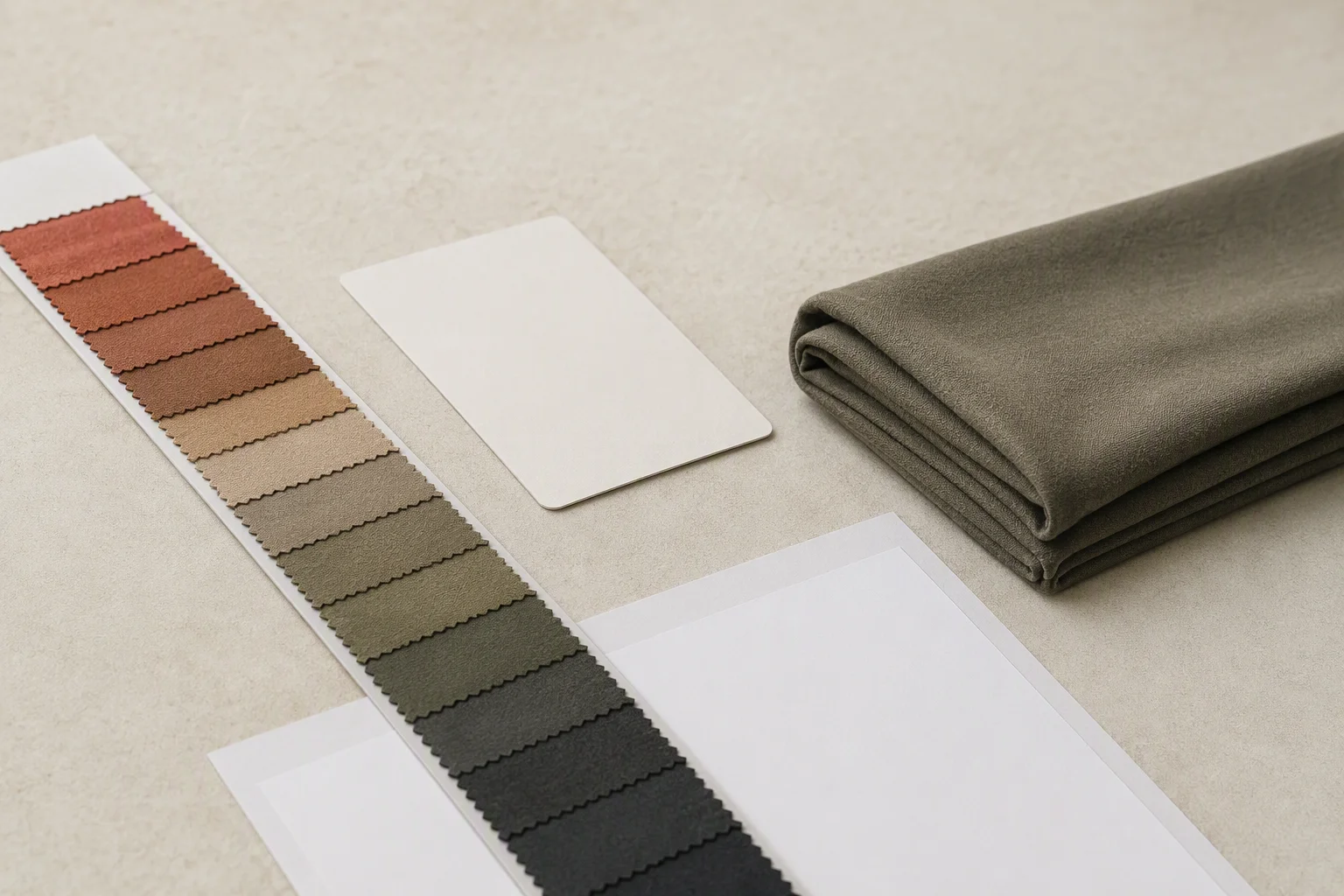
Why Color Is the Slowest Approval in a Hijab Collection
Ask any DTC brand, boutique, or private-label buyer what delays a hijab program more than anything else, and the honest answer is rarely fabric or freight. It is color. A collection can clear fabric sourcing, hit the sampling date, and still stall for two weeks because a dusty rose reads warm under one light and cool under another, or because the bulk lot arrives a visible half-step away from the approved swatch.
Color feels subjective, and that is exactly the problem. When approval depends on a buyer looking at a photo on a phone, every party is guessing. A wholesale-quality color process removes the guesswork by turning shade into a measurable, contractual value: a target reference, a Delta E number, a defined illuminant, and a signed shade band that bulk production must fall inside.
This guide walks through the full color-development chain as we run it at QiuYan Factory - lab dips, dye lots, Delta E interpretation, lighting and metamerism control, and the harder problem of cross-SKU consistency, where the hijab must match a thread, an undercap, a printed label, and packaging that were all produced by different processes.
1. The Color Development Chain: From Tech Pack to Signed Shade Band
Color development is a sequence, and skipping a step only moves the failure downstream into bulk.
1. Reference locked. The buyer submits a color reference: a Pantone FHI TCX chip, a physical swatch, or a previously approved sample. Pantone-to-textile conversion is approximate, so a TCX chip is a starting direction, not a guarantee.
2. Substrate declared. The color is only valid on a defined fabric: fiber, construction, GSM, and finish. A shade approved on 110 GSM polyester crepe is not the same color on 90 GSM jersey or on a 70 GSM poly-cotton voile.
3. Lab dip requested. The dyehouse prepares small dyed pieces on the production fabric using the stated recipe.
4. Instrumental reading. Each dip is measured on a spectrophotometer under D65/10 degrees and compared to the target.
5. Visual review. Dips are evaluated in a controlled light booth against the reference, not on a desk.
6. Round approval or revision. Approved, approved with comment, or re-dip.
7. Bulk dyeing and bulk-lot verification. Production lots are measured again against the approved shade band.
8. Shade audit at cut and sew. Panels from different rolls are checked side by side before garments are bundled.
The realistic budget from a clean tech pack to a signed shade band is 10-14 working days, because each lab dip round consumes 5-7 business days and most colors need two rounds.
2. Lab Dips: How Many Rounds, and What Approval Really Means
A lab dip is a small, sample-dyed piece of the actual production fabric, dyed to the target recipe. We size ours to give the buyer a usable area - typically 20 by 20 cm - so the color can be assessed flat, folded, and against skin tone, not just measured as a single point.
The most common buyer mistake is approving a lab dip that was dyed on a different substrate than bulk. A dyehouse can hit a target perfectly on a 120 GSM interlock and miss it on a 90 GSM crepe, because the same recipe behaves differently on a looser, thinner, or more lustrous surface. Insist on the exact fabric, the exact GSM, and the exact finish. If the finish will include a softener or a calendered hand, the dip must carry that finish too, because finishing shifts shade.
Two to three rounds are normal; more than three usually means the target itself is the problem. If you keep receiving dips that are technically close but visually wrong, the reference is often unattainable on that substrate, or it was supplied as a Pantone value that does not translate. In that case the fastest fix is to approve the best achievable dip as the new master standard and hold bulk to that.
3. Reading Delta E Correctly
Delta E is the numerical distance between two colors in the CIE L*a*b* space, where L* is lightness, a* is the red-green axis, and b* is the blue-yellow axis. A Delta E of 0 means a perfect match; larger numbers mean a larger visible difference. The number is only meaningful when you also know the measurement conditions, because a Delta E of 1.0 under one illuminant can become 2.5 under another.
Three Delta E equations are in circulation. Delta E 76 is the simple Euclidean distance and is still the most common in textile contracts. Delta E 94 and Delta E 2000 add weighting so the number tracks human vision more closely, especially in low-chroma pastel ranges. The practical rule is simple: state the equation in the purchase order, because the same sample can read Delta E 76 at 1.4 and Delta E 2000 at 0.9.
Thresholds we hold bulk to:
- Delta E at or below 1.0: an excellent match; internal target for a single lot and for critical neutrals.
- Delta E at or below 1.5: commercial match; the normal bulk acceptance band for a repeat color.
- Delta E at or below 2.0: marginal; acceptable only for non-adjacent SKUs and low-contrast patterns, and never for white, ivory, or black, where shading is easiest to see.
- Delta E above 2.0: reject and re-dip or re-dye.
Directional drift matters as much as the total number. Two dips can share a Delta E of 1.2, but one is lighter and one is greener, and they will not live together in one collection. Always read DL*, Da*, and Db* separately. A consistent positive Db* across all lots tells you the dyehouse is systematically running bulk cooler, or bluer, than the standard.
4. Lighting, Illuminants, and Metamerism
Two swatches can match under store lighting and separate under daylight. That phenomenon is metamerism, and it is the single biggest cause of post-delivery color disputes. It happens when two colors are produced from different dye chemistry - a disperse-dyed polyester and a reactive-dyed modal, for example - so their reflectance curves cross. They match under one illuminant and diverge under another.
The defense is disciplined multi-illuminant review. Standard textile practice evaluates a shade under at least three sources:
- D65 (average daylight, roughly 6500 K): the primary reference and the source used for instrumental measurement.
- TL84 or TL83 (tri-band fluorescent, roughly 4000 K): representative of many retail and European store environments.
- CWF (cool white fluorescent): common in North American retail.
- Illuminant A (incandescent, roughly 2856 K): the warm domestic light where a customer first unfolds the scarf.
- UV-A: reveals optical brighteners and shows how white a white really is.
Visual assessment should follow a defined protocol rather than an opinion. We use a light booth with controlled D65, TL84, and A settings, a neutral gray surround, and a masked comparison so that no one knows which swatch is the standard. AATCC EP9 and ISO 105-A02 (gray scale for color change) are the reference methods for visual work, and instrumental color difference is commonly assessed to ISO 105-J03.
The workflow is instrumental plus visual, in that order. The spectrophotometer proves the number is inside tolerance; the light booth proves the number still looks right to a human. A sample that passes the instrument but fails three reviewers in the booth should not ship. For white and off-white, add a UV check, because an optical brightener can make a white read blue under daylight and yellow under incandescent.
5. Dye Lots and the Shade Band
Once a color is approved, the question shifts from whether it matches the standard to whether it matches itself across the run. Bulk dyeing is never perfectly uniform. Each dye lot - typically a jet-dyed batch of 500-1,000 kg for polyester, or roughly 300-800 pcs of finished hijab depending on weight - carries its own small deviation.
A shade band is the explicit window that ties lots together. It usually has a documented center, which is the approved standard, plus an upper and a lower limit, and it travels with the order in both physical and numeric form:
- Within-lot uniformity: Delta E at or below 0.8 across the width and length of a roll.
- Lot-to-lot tolerance: Delta E at or below 1.5 between any two lots shipped in one order.
- Same order, same color: all lots inside a single band, and never a marginal lot mixed into a critical neutral.
Where a color is unusually sensitive - ivory, sand, greige, oxblood - we cut physical shade cards from the approved dip and from the first bulk lot, and require the dyehouse to shade-match against the card rather than the recipe. Two dye lots can share a recipe and still land apart, because dye concentration, bath ratio, and machine loading vary. The card removes the argument.
6. Cross-SKU Consistency: Matching the Hijab to Everything Around It
The hardest color problem in a wholesale collection is not the hijab on its own. It is the hijab against the other items in the drop. A single look typically includes the scarf fabric, a matching undercap, a thread, a care-label and hangtag print, a packaging ribbon, and often power mesh, jersey, or a modal trim. Each is a different substrate, and each responds to dye differently.
That is why a brand cannot simply tell a factory to use the same color for everything. The same target produces a different shade on a disperse-dyed polyester jersey, a reactive-dyed modal, a printed satin ribbon, and a woven label. Each needs its own lab dip, and each needs its own tolerance.
A practical cross-SKU rule set:
- Same substrate, adjacent SKUs: Delta E at or below 1.0.
- Different substrates in one look (hijab versus undercap versus trim): Delta E at or below 2.0, and always confirmed in the light booth, never by number alone.
- Non-textile components (ribbon, label print, packaging): treat as a separate approval, because print and dye are not the same medium and will never match exactly.
- Metameric pairs: when the hijab and the trim use different dye classes, require a three-light review before sign-off.
The payoff of getting this right is disproportionate. Cross-SKU consistency is what makes a collection read as designed rather than assembled, and it is the difference between a buyer reordering a color family and a buyer abandoning it.
7. Color Approval Governance: AQL 2.5 and the Bulk Shade Audit
Color failures are not distributed like a stitching defect, so they cannot be caught by statistical sampling alone. A roll that is off-shade is off across its whole length, and an AQL 2.5 sample of 200 pcs can easily miss a lot that is uniformly wrong. The correct approach combines two controls.
First, a statistically valid inspection for workmanship. We run AQL 2.5 for major defects and AQL 4.0 for minor defects on a normal inspection level, in line with ISO 2859-1. Color-related workmanship issues such as shading, streaks, and dye spots are classified as major.
Second, a dedicated shade audit that is not statistical. Every dye lot in the shipment is measured against the approved shade band, and one cut panel from each roll is compared in the light booth, side by side, against the master standard. On a critical neutral we sample 10 percent of rolls per lot and require every draw to fall inside tolerance. A mismatch is obvious the moment two panels sit next to each other under D65, and it is far cheaper to catch at the factory than in a customer's hands.
8. Factory Parameters You Can Hold a Supplier To
Every number below is one we write into a purchase order, and one any serious supplier should be willing to commit to.
- Fabric weight: 60-130 GSM depending on article, with a tolerance of plus or minus 5 percent on the specified GSM.
- Color tolerance: Delta E at or below 1.0 internal, at or below 1.5 commercial bulk, at or below 2.0 maximum cross-substrate; the equation is stated (Delta E 2000 preferred, Delta E 76 accepted).
- Within-lot uniformity: Delta E at or below 0.8 across roll width and length.
- Lab dip rounds: 2-3 rounds, 5-7 business days per round, on the exact production fabric and finish.
- Visual assessment: D65, TL84, and illuminant A, neutral gray surround, masked comparison, per AATCC EP9 and ISO 105-A02.
- Instrumental method: spectrophotometer under D65/10 degrees, four readings per sample, ISO 105-J03.
- Bulk production: 15-20 working days after the pre-production sample and shade band are approved.
- Inspection: AQL 2.5 major and 4.0 minor to ISO 2859-1, plus a lot-by-lot shade audit.
- Dye lot size: typically 500-1,000 kg per lot; larger orders split into lots that must all sit inside one shade band.
9. How QiuYan Factory Runs Color Development
At QiuYan Factory we treat color as a document, not a discussion. Every program starts with a locked substrate and a written tolerance, moves through lab dips measured on a spectrophotometer and reviewed in a controlled light booth, and ends with a signed shade band that bulk must fall inside. Buyers receive the instrumental readings, the illuminant notes, and physical shade cards alongside the pre-production sample, so the approval is defensible to a merchandiser, a photographer, and a customer.
For wholesale collections that ship across Europe, the Gulf, Southeast Asia, and North America, that discipline is what keeps a color family intact from the first reorder to the fifth.
To start a color development project, send your reference, substrate, and target color family to melody@wennuanfactory.com or reach the team on +86 150 2459 7603. We will confirm substrate feasibility, propose lab dip rounds, and return a shade band you can hold production to.
Frequently Asked Questions
How many lab dip rounds does a hijab color need, and how long does color approval take?
Most colors need two rounds, and a difficult or highly saturated shade can need three. Each round runs 5-7 business days because the dyehouse must dye, dry, and condition the sample on the exact production fabric. Budget 10-14 working days from a clean tech pack to a signed shade band, and treat that color window as a fixed gate before bulk. Bulk production itself then runs 15-20 working days after the pre-production sample and shade band are approved.
What Delta E is acceptable for hijab bulk production?
We hold bulk to Delta E at or below 1.0 as an internal target, at or below 1.5 as the normal commercial acceptance band, and at or below 2.0 only for cross-substrate matching that cannot be tighter. Anything above 2.0 is rejected and re-dyed. Always specify the equation in the purchase order (Delta E 2000 preferred, Delta E 76 accepted), because the same sample can read differently under each, and always read DL*, Da*, and Db* separately so you can see whether a lot is running light, red, or blue.
Why does my hijab match in the factory but look different in the store?
This is metamerism: two colors made with different dye chemistry match under one light and separate under another. It is most common when the hijab and a trim, undercap, or printed component are dyed by different processes. The defense is multi-illuminant review under D65, TL84, and incandescent illuminant A in a controlled light booth, plus a UV-A check for white and off-white. If a sample only matches under a single light source, treat it as a risk and request a re-dip or a different dye class.
Ready to Order