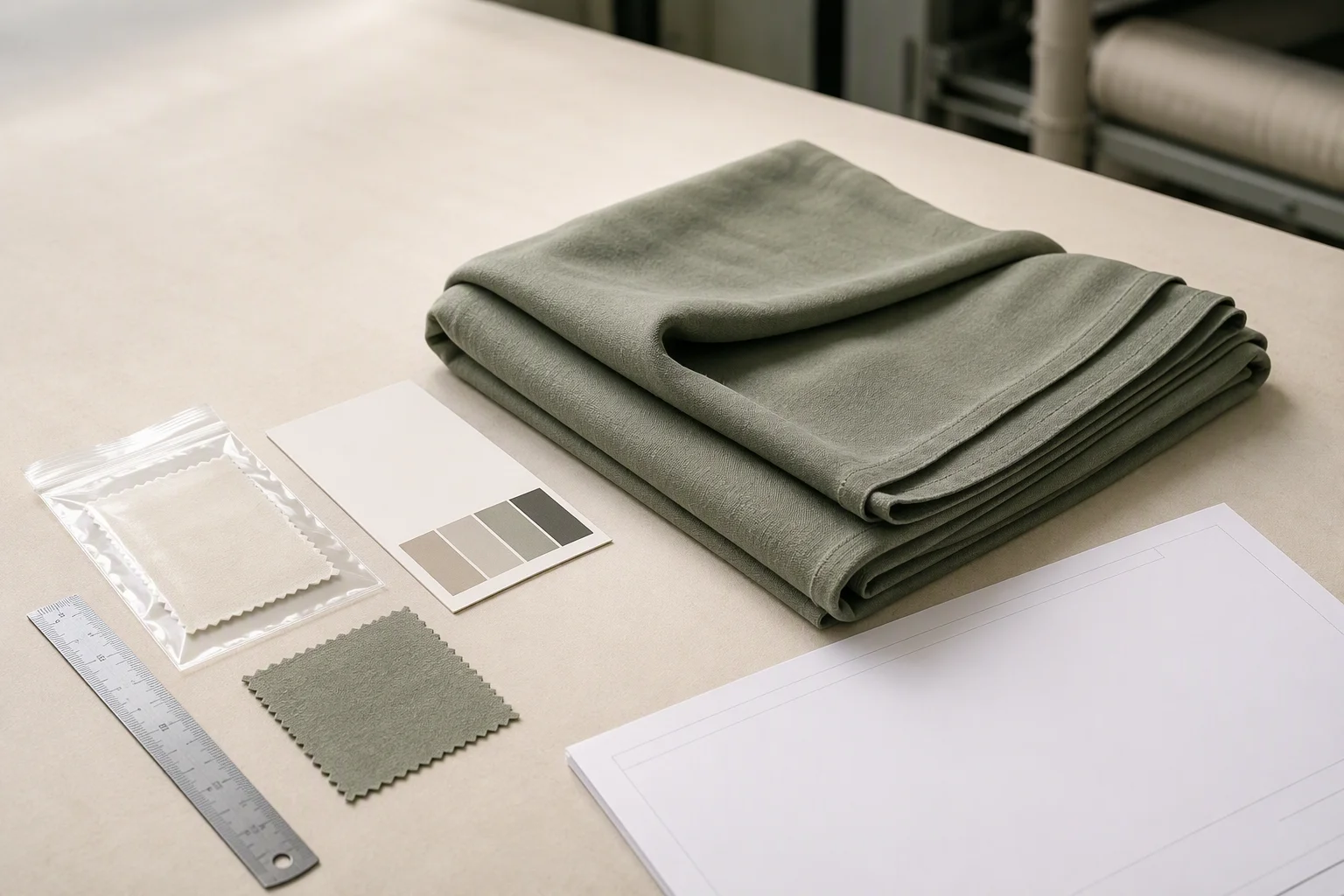
Executive Summary: Wash Performance Is a Commercial Requirement
A hijab can look correct when it leaves the cutting table and still disappoint a customer after its first wash. The scarf may lose more length than expected, the edge may curl, the color may transfer during rubbing, or the surface may develop fuzz. For a DTC brand, these are not only laboratory issues. They become returns, customer-service tickets, inconsistent repeat purchases and damage to trust.
Wholesale and private-label buyers therefore need a wash-performance specification before bulk production. The specification should connect the fabric, finished dimensions, dye or print process, edge construction, care label and inspection plan. It should also identify which results are measured numerically and which results require visual approval.
This factory-side guide explains how to build that control plan for modal, jersey, bamboo viscose, Tencel Lyocell and textured hijab programs. It covers GSM, shrinkage, dimensional tolerance, colorfastness, pilling, edge performance, test sampling, AQL 2.5 and production timing.
The aim is practical: create an approval process that lets a buyer compare samples with bulk production and identify problems before the shipment reaches the warehouse.
---
1. Write the Wash-Test Brief Before Sampling
A wash test is only meaningful when the conditions are defined. Before requesting a sample, the buyer and factory should record:
1. Fiber composition and fabric construction.
2. Target GSM, meaning grams per square meter, with an agreed tolerance.
3. Finished length and width.
4. Edge finish, such as baby rolled hem, pin hem, overlock or hand-rolled hem.
5. Intended care method and water temperature.
6. Drying method and whether ironing is allowed.
7. Number of wash cycles for approval.
8. Color standard and light source for visual comparison.
9. Inspection points and pass/fail criteria.
A generic 鈥渨ash and check鈥?instruction is too vague for a production order. A 70 GSM modal scarf and a 180 GSM jersey scarf will not respond identically to the same process. A printed scarf may need additional review for color transfer, while a plain scarf may require closer attention to surface fuzz and edge recovery.
The factory should keep one unwashed reference and one approved washed reference. Both should be identified with the product code, color, lot information and test date. This makes later comparisons more reliable than relying on memory or a photograph taken under unknown lighting.
---
2. Control GSM and Fabric Construction
GSM is the weight of fabric per square meter. It is not a complete description of quality, but it is a useful production-control number. If a brand approves a lightweight 30s modal hijab, a large GSM shift can change opacity, drape, warmth, edge behavior and shipping weight.
For many lightweight modal development programs, a target range around 60鈥?0 GSM may be considered, depending on weave density, finishing and intended coverage. Jersey programs may use a different range because knitted construction has stretch and recovery. The buyer should approve the target with a physical sample rather than selecting a number in isolation.
During bulk inspection, sample fabric from different rolls or pieces rather than measuring only one location. Record the test area, scale condition and result. If the average is within range but one roll is visibly heavier or lighter, the visual effect may still be unacceptable when the shade and drape are compared side by side.
Construction also matters. Woven modal, knitted jersey and textured jacquard respond differently to washing. A knitted scarf may change length and width through relaxation. A woven scarf may show skew or bowing. A jacquard may lose relief if the finishing process is too aggressive. The wash plan should therefore identify the construction before the test begins.
---
3. Measure Shrinkage and Finished Dimensions
Shrinkage is the change in size after washing and drying. Measure the actual finished scarf before and after the agreed care process. For a rectangular hijab, record length, width and, where relevant, the distance between border or repeat points.
A useful calculation is:
Shrinkage percentage = (pre-wash measurement 鈭?post-wash measurement) 梅 pre-wash measurement 脳 100
The result should be evaluated separately for length and width. A scarf can remain within a general size tolerance while developing a noticeable change in one direction. This is particularly important for a border print or directional jacquard motif.
For a finished size such as 180 脳 70 cm or another buyer-approved dimension, a starting production tolerance of 卤1.0 cm can be discussed. The final tolerance should be written into the technical pack and linked to the measurement method. State whether the measurement is taken relaxed, stretched, folded or after conditioning.
Skew and bowing
Skew is the diagonal displacement of the fabric structure. Bowing is a curved distortion of a crosswise line. Both can be visible when a scarf is laid flat or styled around the face. To check them, align the scarf on a flat inspection surface and compare the border, weave line or printed repeat with the edge.
A garment measuring tape alone cannot fully describe skew. Record the visual condition and, for repeat programs, agree on a maximum deviation that the buyer will accept. The important point is consistency: the same method should be used for development, bulk inspection and any claim investigation.
---
4. Test Colorfastness on the Finished Product
Colorfastness describes how well a color resists change or transfer during use. The relevant risk depends on the product. A dark modal scarf may transfer color through rubbing. A printed scarf may show fading or bleeding during washing. A sweat-worn under-cap may be exposed to perspiration and repeated friction.
A buyer should ask the factory to identify the intended test method and the result scale before approval. Common evaluations may include:
- wash color change and staining;
- dry and wet rubbing transfer;
- perspiration response;
- light exposure where the product's use case justifies it;
- print durability for digitally printed or screen-printed surfaces.
Do not inspect only a loose fabric swatch when the final product has a different edge or finishing process. The finished scarf should be tested because stitching, heat, softening and pressing can influence the result.
Visual color approval
Instrument readings support color control, but a number does not replace visual review. Keep an approved shade standard and compare the test sample under a consistent light source. If a buyer uses a light box, record the selected lighting condition. If the product uses a textured surface, view it flat, folded and draped because the relief changes the way light is reflected.
For repeat production, the factory can record a Delta E value, meaning the numerical difference between a target and a sample color. A buyer may specify a tighter value for a smooth premium surface and a documented exception for heathered, textured or intentionally washed effects. The threshold must be agreed before bulk production rather than argued after delivery.
---
5. Review Pilling, Fuzz and Surface Recovery
Pilling is the formation of small fiber balls on the surface. Fuzz is a raised fiber effect that may appear before visible pills form. Both can be influenced by fiber length, yarn construction, knitting or weaving density, finishing and care method.
The development sample should be inspected after the agreed wash cycles and after controlled rubbing or wear simulation. Look at high-contact areas such as the face edge, shoulder area and places where a pin or under-cap may touch the scarf. Use the same light direction for each comparison.
Modal and bamboo viscose can feel smooth, but smooth hand feel does not automatically predict long-term surface performance. Jersey stretch can also expose small fibers differently from a stable woven fabric. For a premium program, ask the factory to document the finishing process, such as bio-polishing or softening, and confirm that the selected finish does not reduce the desired drape.
A buyer should avoid approving a sample only because it feels soft on day one. The commercial question is whether the surface remains acceptable after the care process the customer is likely to follow.
---
6. Edge Performance After Washing
The edge is one of the most visible areas of a hijab. A wash test should check whether the hem becomes wavy, curls inward, frays, loses its shape or changes width.
For a baby rolled hem, measure the finished roll width at several points. A practical target around 1.0鈥?.5 mm may be suitable for a precise lightweight finish when the fabric is stable and the machine settings are controlled. The final target should be agreed with the sample because the same nominal width can look different on modal, chiffon and jersey.
For a pin hem, check the folded edge, stitch security and skipped-stitch rate. For a hand-rolled hem, inspect the consistency of the roll, thread tension and visible labor variation. For an overlocked edge, check whether the thread remains secure after washing and whether the edge feels too bulky for the intended styling.
The inspection should compare the washed edge with the approved unwashed reference. Take measurements at the corner, mid-edge and opposite corner. An edge can pass at the center and fail at a corner if the tension or cutting direction is inconsistent.
---
7. Sampling Plan: Do Not Test Only the Best Piece
A reliable development plan uses samples that represent the actual production risk. One carefully selected sample can confirm the design, but it cannot demonstrate lot consistency.
For development, request at least one finished sample for each distinct fabric, color and edge construction. If a dark color, bright color and printed version will share the same base fabric, test the color process that creates the highest risk. If the product will be sold in several sizes, test the size with the most demanding edge or border placement.
During bulk production, sample from different rolls, cutting sections or production time points. Mark the sample identity so the test result can be traced back to the lot. The factory should not replace a failed sample with a different piece without recording the change.
When the buyer receives the bulk reference, compare it with the approved sample in four conditions: flat and relaxed, folded, draped and after the agreed wash process. This simple visual routine often reveals differences that a single flat measurement misses.
---
8. AQL 2.5 and the Final Quality Gate
AQL 2.5 is a sampling framework used for acceptance inspection. It helps define the sample size and defect acceptance decision, but it does not replace the product specification.
For a hijab shipment, the defect list should include:
- incorrect color or visible dye-lot variation;
- size outside the agreed tolerance;
- skew, bowing or border misalignment;
- stains, holes, oil marks or pulled yarns;
- pilling, excessive fuzz or surface damage;
- loose, skipped or uneven edge stitches;
- incorrect label, packaging or SKU;
- color transfer or wash result outside the approved requirement.
Classify critical, major and minor defects before the inspection. Record measurements, photographs and lot references. If the shipment is being checked for color, use the approved shade standard and light condition rather than judging under mixed warehouse lighting.
AQL 2.5 does not mean that every individual piece has zero defects. It means the shipment is evaluated through an agreed sampling decision. If the buyer requires additional 100% checks for a specific issue, such as a premium hand-rolled hem or a high-risk dark color, write that requirement separately.
---
9. Production Timing and Approval Handoffs
Wash testing must be included in the production calendar. Do not schedule it after packaging is already printed or after the shipment date is fixed.
A practical sequence is:
1. Confirm fiber, GSM, finished size and edge construction.
2. Produce the first finished sample.
3. Measure pre-wash dimensions and record the initial appearance.
4. Apply the agreed wash and drying process.
5. Measure shrinkage, edge width, surface condition and color response.
6. Approve the sample or issue a documented correction.
7. Repeat the test when the fabric, dye process, finish or edge construction changes.
8. Lock the approved reference before bulk production.
9. Include wash-related defects in the final AQL inspection plan.
For a standard private-label development program, a finished sample can often be planned in 5鈥? business days after the fabric, color and measurement requirements are complete. Bulk production may take approximately 15鈥?0 working days after the approved sample and production details are signed off. Special textures, custom printing, hand-rolled edges or additional laboratory work may require a longer schedule.
The factory should keep the approval record with the production lot. The buyer should keep a matching copy. This prevents a common dispute in which both sides remember approving a sample but cannot identify which version was actually approved.
---
10. Buyer Checklist Before Releasing the Order
Before bulk production, confirm:
1. Fiber composition and target GSM are documented.
2. Finished dimensions and 卤1.0 cm starting tolerance are discussed and recorded where applicable.
3. Pre-wash and post-wash measurement methods are defined.
4. Colorfastness, rubbing and perspiration checks are assigned to the actual finished product.
5. Delta E method and visual shade-approval conditions are agreed.
6. Pilling, fuzz and surface-recovery expectations are documented.
7. Edge width, stitch security and post-wash appearance are approved.
8. AQL 2.5 defect categories and any additional 100% checks are written.
9. Development, approval and bulk-production dates are realistic.
10. The retained reference sample is labeled with the product and lot information.
A documented wash-test plan protects both sides. It helps the factory control production and gives the buyer a clear basis for approving the bulk shipment. More importantly, it connects the product promise shown on a DTC product page with the physical performance customers experience at home.
For a wholesale or private-label wash-performance review, send the target fabric, finished size, edge construction, color standard and care requirements to our technical team:
- **Direct Factory Email:** [melody@wennuanfactory.com](mailto:melody@wennuanfactory.com)
- **B2B WhatsApp:** [+86 150 2459 7603](https://wa.me/8615024597603?text=Hello%20QiuYan%20Factory%2C%20I%20am interested%20in%20hijab%20wash%20testing%20and%20private-label%20production.)
QiuYan Factory supports modal, jersey, bamboo viscose, Tencel Lyocell, textured and private-label hijab programs with factory-side sampling, production control and pre-shipment quality inspection.
Frequently Asked Questions
What shrinkage tolerance should a wholesale buyer specify for hijabs?
For a stable modal or jersey program, a buyer can begin with a finished-size tolerance of 卤1.0 cm and a separately agreed wash-shrinkage target. The exact limit depends on the fabric structure and care route, so approval should be based on pre-wash and post-wash measurements of the finished scarf, not on greige fabric alone.
How should colorfastness be checked before a private-label hijab shipment?
Test the actual finished product, including the edge treatment and any print or jacquard surface. Review wash, rubbing and perspiration performance under the buyer's intended care method, then compare the sample with the approved color standard under a consistent light source. Keep the test record linked to the production lot.
Does AQL 2.5 guarantee that every hijab is defect-free?
No. AQL 2.5 is a sampling framework that defines how a shipment sample is inspected and how defects are classified. It should be used together with a clear defect list, measurement tolerances, color criteria, packaging checks and a pre-shipment inspection report.
Ready to Order