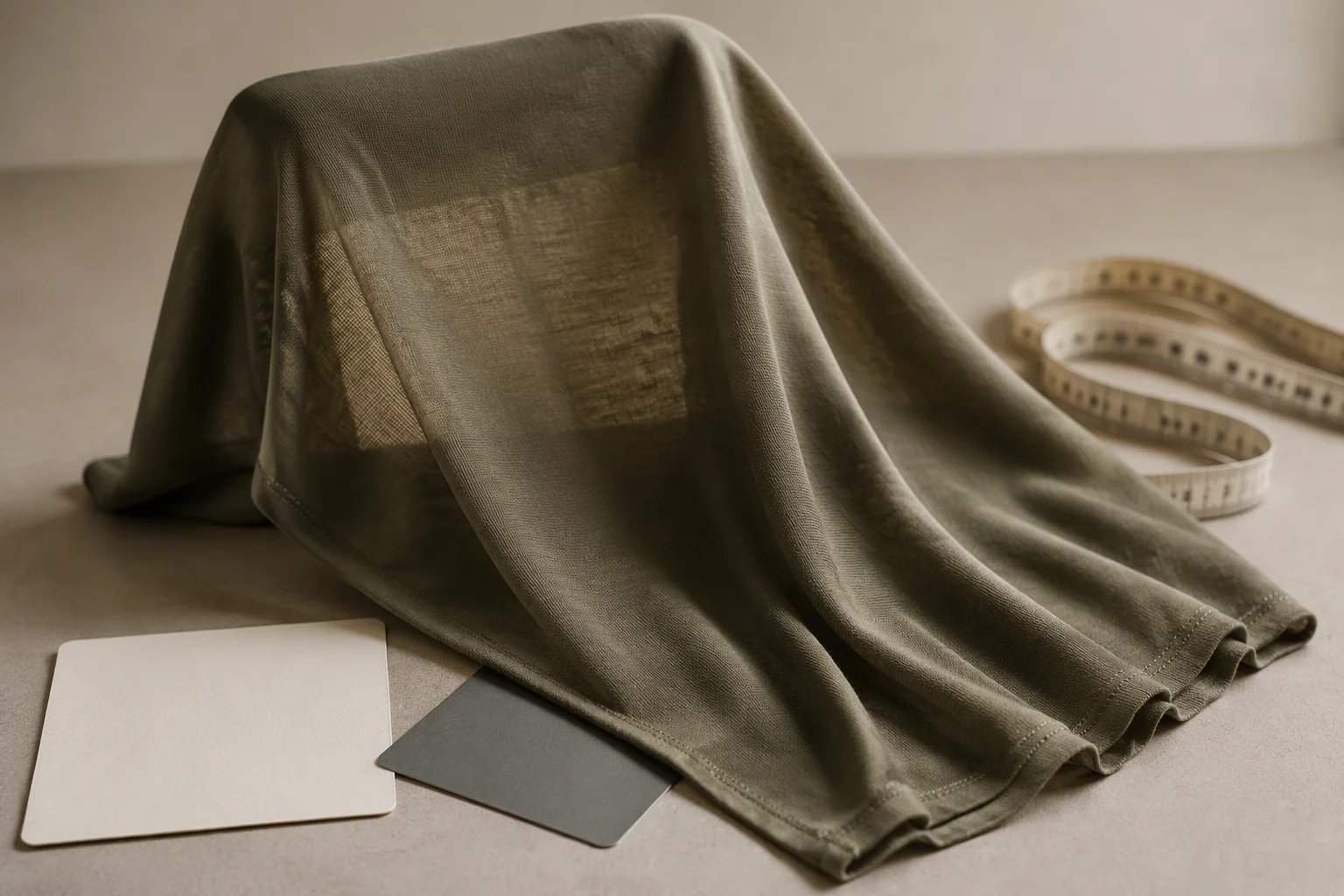
Across modest-fashion product reviews, one complaint shows up more than any other: the fabric is thinner, lighter, or more see-through than the buyer expected. Industry analysis of modest-fashion reviews puts 'fabric thinner than expected' at the top of the complaint list, ahead of sizing problems. For a hijab — a product worn over the head and framing the face in public — insufficient opacity is not a minor tolerance issue. It is a dealbreaker that drives returns, one-star reviews, and lost repeat customers.
The frustrating part is that it is almost entirely preventable. 'Too thin' is rarely a manufacturing defect in the usual sense; it is a specification failure. The brand approved the style on hand-feel, a flattering studio photo, or a vague adjective like 'premium', and never pinned opacity down as a measurable requirement. This guide explains how a factory specifies, tests, and controls fabric opacity and coverage so that the number-one return driver is designed out before bulk ever runs.
Part 1: Why 'too thin' is a specification problem, not just a fabric problem
When a brand tells us a competitor's hijab 'feels cheap and see-through', the root cause is usually that nobody ever wrote down what adequate coverage means. Opacity got left to chance.
The trap is that fabric can feel substantial in the hand and still fail as worn. A soft, fluid modal drapes beautifully and feels lovely between the fingers, but stretched over the head under bright daylight it can reveal scalp and hairline. Hand-feel measures softness; it does not measure light transmission. Those are different properties, and only one of them shows up in customer photos.
The second trap is lighting. A hijab photographed in soft studio light looks opaque; the same piece under direct sun, office LED panels, or a camera flash can turn sheer. Customers wear hijabs in exactly those harsh conditions, so the real-world test is the harsh one, not the flattering one.
The fix is to convert a subjective worry into objective numbers and a physical benchmark: a weight target, a construction target, and a repeatable opacity test, all locked on the approved sample. The rest of this guide covers each.
Part 2: The three levers that control opacity
Opacity is governed by how much fiber sits between the light source and the skin, and how that fiber is arranged. Three parameters capture it.
GSM (grams per square meter) — the weight lever. GSM is the single most useful opacity proxy. More fiber per unit area blocks more light. For a standard everyday modal square we target 110-130 GSM; premium and winter opaque lines run 140-180 GSM. Below roughly 100 GSM, plain modal starts to risk sheerness on lighter hair and skin under bright light.
Cover factor — the construction lever. Cover factor describes how tightly the yarns are knitted or woven together — effectively how much of the fabric area is fiber versus gap. Two fabrics at the same GSM can differ in opacity if one is knitted tight and dense and the other loose and open. This is why weight alone is not a guarantee: a heavy but slackly constructed knit can still transmit light through the gaps.
Yarn and finish — the fiber lever. Yarn fineness, fiber type, and finishing all shift opacity. A matte, slightly brushed finish scatters light and reads as more opaque; a high-sheen calendered finish can look slightly more translucent. Darker dye shades read as more opaque than pale ones, which is why a design that works in charcoal may fail in off-white at the same GSM. We flag colors that need a weight bump to stay opaque.
Specifying all three — not just GSM — is what makes opacity reliable across a range.
Part 3: How we test opacity before bulk
Numbers on a spec sheet only matter if they are verified on real fabric. We use a layered set of checks, moving from lab data to practical worn-condition tests.
Grey-card / print-through test. We lay a single layer of the fabric over a standard grey card or a printed line sheet and grade, under controlled lighting, how much shows through. This is quick, repeatable, and gives a clear pass/fail against an agreed reference.
Skin-tone board under bright light. Because the real failure case is the fabric worn over skin in harsh light, we assess a single layer over a skin-tone board under a bright, direct light source. This replicates the daylight-and-flash conditions where sheerness actually embarrasses the wearer.
Backlight check. Holding the single layer against a diffuse light panel reveals thin spots, uneven knit density, and gaps that a flat-light inspection misses.
The approved sample as benchmark. Crucially, once a sample passes, that physical piece becomes the opacity benchmark for the order. Bulk is inspected against the actual approved sample, not just a number, which removes arguments about interpretation.
These tests are cheap, fast, and decisive. Running them at the sample stage costs minutes; discovering the failure through customer returns costs the relationship.
Part 4: Writing opacity into the tech pack
To make opacity enforceable it has to live in the specification document, in language the factory can inspect against. We record it as a small, clear block.
Target GSM with tolerance. For example 120 GSM +/- 5%. The tolerance matters because fabric naturally varies slightly batch to batch; +/- 5% is a realistic, holdable band.
Cover factor / construction note. The knit type and density, so a supplier cannot hit the weight with a loose, sheer construction.
Opacity pass/fail reference. The named test (grey-card and skin-tone board) and the approved-sample benchmark the bulk must match.
Color-specific flags. Any pale shades that require a GSM bump to stay opaque, noted per colorway.
Dimensional and other specs alongside. Opacity sits with the rest of the spec — finished size at +/- 2 cm tolerance, color at ΔE 1.0 against the lab dip, edge finish, and so on — so the whole product is defined, not just its weight.
With this block in the tech pack, 'make sure it is not see-through' becomes a set of checkable criteria instead of a hope.
Part 5: Holding opacity through bulk production
A sample passing opacity is only useful if bulk matches it, and weight and density can drift if they are not watched. We control this in production.
Incoming fabric QC. We check GSM on incoming knitted fabric against the target before cutting, so an out-of-spec lot is caught at the roll, not at the finished piece.
In-line checks. Density and thin-spot checks during production catch knitting faults early.
AQL 2.5 final inspection. The finished batch is inspected to AQL 2.5 (Acceptance Quality Limit — the statistical sampling standard defining how many defective pieces are tolerable in a batch), and opacity against the approved sample is part of that inspection, not an afterthought.
Batch records. GSM readings per lot are recorded, so a reorder can be matched to the original and a brand has traceability if a question ever arises.
This is the difference between a factory that treats opacity as a controlled parameter and one that only reacts after a shipment is rejected.
Part 6: Balancing opacity against drape, weight, and cost
More opacity is not automatically better, because the heaviest fabric is not always the right product. The craft is in the balance.
Opacity vs drape. Pushing GSM too high makes a hijab stiff and bulky, losing the fluid drape that defines a modal or the lightness of a summer piece. The goal is the lightest fabric that still passes opacity, not the heaviest possible.
Opacity vs breathability. Denser, heavier fabric is warmer. For Gulf summer lines or sport styles, we may hold opacity with a tighter construction and matte finish rather than brute weight, keeping the piece cool.
Opacity vs cost. More fiber costs more. But under-specifying to save a few cents per piece and then absorbing a 20% return rate is a false economy. The right target is the one that passes the worn test with margin, chosen deliberately.
Two-layer and lining options. For intentionally lightweight or luxury-sheer fabrics like silk chiffon, coverage can be solved by design — a double-layer wrap or a coordinated under-piece — rather than by thickening the fabric and killing its character.
We talk brands through these trade-offs per style so opacity is solved without sacrificing the hand and drape that make the product desirable.
Part 7: How buyers should vet a supplier's opacity control
Before the first order, a brand can tell a lot about whether a factory treats opacity as a controlled parameter simply by how it answers a few questions, and asking them upfront saves a painful first shipment.
Ask for GSM, not adjectives. A capable supplier states the GSM and tolerance for a quality without hesitation. If the answer is only 'it is good quality' or 'premium thick', opacity is not being measured, and 'too thin' is a risk waiting to happen.
Ask how they test see-through. A factory that controls opacity can describe a concrete method — a grey-card or print-through test, a skin-tone board under bright light, a backlight check. 'We just look at it' is not a method.
Request a worn-condition reference, not a studio photo. Ask to see or receive a single-layer sample you can test yourself under daylight and flash. Approving on a soft studio image is how brands get surprised; testing the physical piece in harsh light is how they avoid it.
Confirm bulk is matched to the sample. Ask whether final inspection checks opacity against the approved sample and at what AQL. A supplier that inspects to AQL 2.5 and names the approved sample as the benchmark is controlling the risk; one that cannot answer is leaving it to chance.
Check reorder traceability. Ask whether GSM readings are recorded per lot so a reorder matches the original. Without records, a reorder six months later can drift thinner and reopen the whole problem.
The quality of these answers predicts the quality of the shipment. A supplier fluent in opacity control is one that has solved the number-one return driver for other brands already.
Conclusion
The most common reason a hijab gets returned is also one of the most preventable. 'Too thin' and 'see-through' are not bad luck; they are the result of approving a style without specifying and testing opacity. Lock a GSM target with tolerance, specify the construction so weight cannot be faked with a loose knit, run the grey-card and skin-tone-board tests, make the approved sample the physical benchmark, and inspect bulk to it under AQL 2.5. Do that and the number-one return driver is handled before a single piece ships.
QiuYan Factory produces modal, jersey, bamboo viscose, and Tencel Lyocell hijabs with specified GSM, cover factor, and opacity benchmarks for DTC brands, boutiques, and OEM/ODM buyers across Europe, the Gulf, and North America. To set opacity targets for your line or request a tested sample, email melody@wennuanfactory.com or message WhatsApp +86 150 2459 7603.
Frequently Asked Questions
Why is 'fabric thinner than expected' the most common hijab complaint, and how do I prevent it?
It happens because brands approve a style on hand-feel or a photo and never specify opacity as a measurable requirement. The fix is to lock three numbers in the tech pack before bulk: GSM (fabric weight per square meter), cover factor (how tightly the knit is constructed), and a pass/fail opacity result from a defined test. When those are approved on the sample and inspected on bulk, 'too thin' and 'see-through' stop being surprises. We help brands set realistic targets per fabric type. Email melody@wennuanfactory.com or WhatsApp +86 150 2459 7603.
What GSM should a modal hijab be to avoid being see-through?
For a standard everyday modal square we recommend 110-130 GSM; below roughly 100 GSM a plain modal starts to show scalp and hairline on lighter skin tones and under bright light, which is the number-one cause of returns. Winter and premium opaque lines run heavier at 140-180 GSM. But GSM alone is not enough — a loosely knit heavy fabric can still be sheer, so we pair the weight target with a cover-factor check and a direct opacity test rather than trusting weight by itself.
How do you actually test opacity before approving bulk production?
We use two practical checks alongside the lab data. First, the grey-card / print test: lay the single-layer fabric over a standard grey card or printed line sheet and grade how much shows through under controlled lighting. Second, we assess coverage as worn — single layer over a skin-tone board under bright light, since that is the real-world failure case. These are recorded on the approved sample so the standard is objective, then we inspect bulk to the same reference under AQL 2.5. The approved sample becomes the physical opacity benchmark the whole order is held to.
Ready to Order