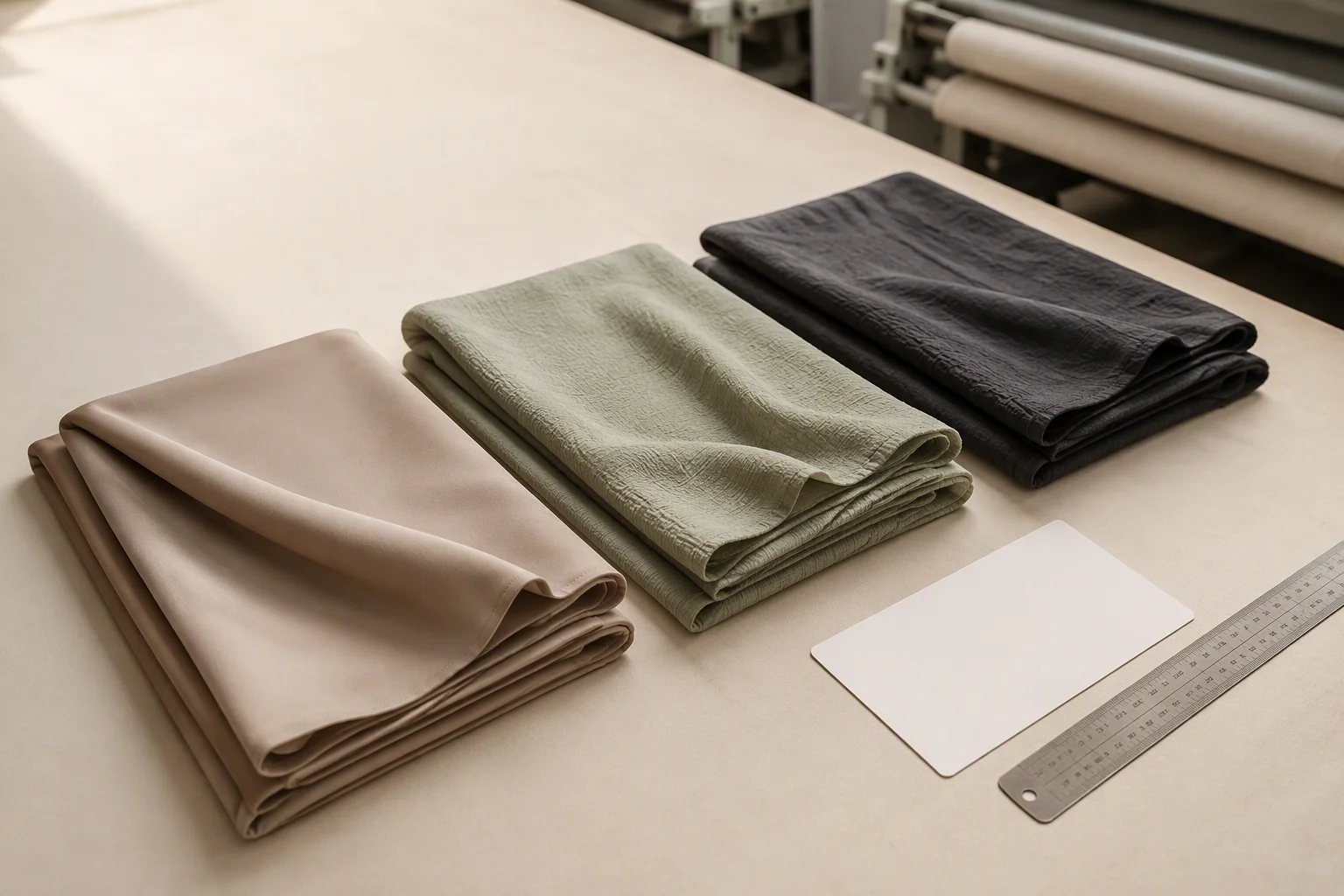
Why Finishing, Not Fiber, Decides How a Hijab Feels
A buyer can spend months choosing between a 95 GSM woven voile and a 110 GSM knit crepe, approve the color, and still open the bulk carton to a hijab that drapes like paper or slips off the head. The reason is almost never the fabric construction. It is the finishing line. Softening, bio-polishing, brushing, calendering, and anti-static treatment are the last operations a hijab passes through before inspection, and they rewrite the two properties a customer judges within three seconds: hand-feel and drape.
For a DTC brand, a boutique, or a private-label buyer building a hijab range for North America, Europe, or the Gulf, finishing is where a technically correct fabric becomes a product that either returns or repeats. It is also where the most expensive mistakes hide, because a finish that makes a swatch feel luxurious on the table can quietly stiffen the cloth, add weight, or kill the fluid fall a hijab depends on. This guide covers the finishing toolkit as we run it at QiuYan Factory: what each finish does mechanically, what it costs in GSM and drape, and how to specify it with tolerances you can actually enforce.
The Physics You Are Selling: Hand-Feel vs Drape
Hand-feel and drape are different properties driven by different mechanics, and conflating them is the most common specification error we see.
Hand-feel is a surface and compression property. It is governed by fiber fineness, yarn twist, fabric surface friction, and the finish film left on the cloth. It is what the customer feels between the fingers.
Drape is a structural property. It is governed by bending rigidity, shear stiffness, fabric weight, and thickness. It is what makes a hijab fall in soft folds instead of standing away from the head.
A finish can improve one and destroy the other. A heavy silicone softener can make fabric feel wonderful while adding weight that changes how it hangs. A hard calendering pass can deliver a smooth surface while raising bending rigidity enough to remove the fluidity. For that reason we specify every finishing route against measurable targets rather than adjectives:
- Weight: GSM held to plus or minus 5% against the approved standard.
- Drape: drape coefficient percentage, measured on a drape tester, with a typical hijab band of 40-65% depending on the silhouette.
- Bending: bending rigidity in mN.mm on a KES-F or FAST system, used to catch stiffening before bulk runs.
- Air permeability: 80-200 mm/s for breathable lightweight collections.
- Surface: friction and roughness indices, or an agreed physical handle reference kept sealed beside the sample.
The rule we give every buyer is simple: approve a finish on the production fabric, never on a swatch of a different construction, and never from a photograph.
Softening Systems: Silicone, Cationic, and Hydrophilic
Softening is the most requested finish and the easiest to over-apply. Softeners deposit a lubricating film on the fiber surface that lowers friction between yarns, letting them slide instead of lock. That sliding is what the hand reads as softness.
Three families cover most hijab programs:
- Non-ionic and cationic softeners give a full, cushioned hand and work well on woven voile and challis. They are efficient but can yellow under heat and are not ideal for whites.
- Silicone softeners, amino-functional and block types, deliver a slick, silky hand and improve crease recovery. Amino silicones give the strongest softness but can shift shade on pale and pastel colors, so every treated lot must be re-read against the Delta E band.
- Hydrophilic softeners preserve moisture management and wicking, which matters for humid Gulf markets and for athletic-adjacent modest wear.
The drape trap in softening is weight gain. A softener add-on of 1-3% on weight of fabric is normal; above that, the fabric gains body and the drape coefficient climbs. We cap softener add-on and re-measure drape after finishing, not before, because the two numbers rarely move together.
Bio-Polishing: Enzyme Smoothing Without Surprises
Bio-polishing uses cellulase enzymes to nibble away protruding fiber ends on cellulosic fabrics such as cotton, viscose, and their blends, producing a permanently smooth surface and a softer hand that survives repeated laundering. Unlike a softener film, bio-polishing changes the fiber itself, so the effect does not wash out.
Two parameters decide whether bio-polishing helps or hurts a hijab:
- Weight loss. A controlled bio-polish removes roughly 2-5% of fabric weight. On a 90 GSM voile that is up to 4.5 GSM, a real change in hand and a small transparency risk, so we test air permeability and opacity after treatment and keep the finished GSM inside the plus or minus 5% band.
- Strength loss. Enzymatic action can reduce tear and tensile strength. We require treated fabric to retain at least 80% of untreated tear strength, verified per batch.
Bio-polishing pairs well with a light silicone softener on woven voile, giving a smooth, cool hand without a heavy film. It is a poor choice for very low GSM sheers where transparency is already a concern.
Brushing and Peach Finish: Surface Hand Without Losing Body
Brushing raises fine fiber ends to create a sueded, peach-skin surface. On hijab it delivers a matte, velvet-touch effect that photographs beautifully and feels warm, which suits autumn and winter collections.
Brushing is a mechanical finish, so its effect is set by roller speed, contact pressure, and the number of passes. Over-brushing is the main risk: it can thin the fabric, reduce GSM, and encourage pilling. We set a light single-pass peach finish for hijabs, verify GSM before and after, and hold the final weight inside the plus or minus 5% band.
Because brushing alters surface friction, it changes hand-feel far more than drape. That makes it a useful tool when you want a differentiated touch while protecting the fall of the cloth, but it must be tested for pilling and for how it interacts with folding, packaging, and any inner layer worn beneath it.
Calendering and Schreiner: Gloss, Density, and the Drape Trap
Calendering passes fabric between heated rollers under pressure to flatten the surface, close the weave, and add luster. A Schreiner calender, with its engraved roller, produces a subtle pearlescent sheen and a closed, smoother hand; a flat calender produces a general gloss.
Calendering is where drape is most often damaged. Pressure and heat increase fiber packing and bonding, which raises bending rigidity and makes the cloth stiffer and papery. The tighter you calender for shine, the more the fabric stands away from the head instead of falling.
Our approach is to calibrate calendering against drape, not just gloss. We run a series of pressure settings, measure drape coefficient and bending rigidity at each, and pick the lightest pass that still delivers the target surface. For sheer, fluid silhouettes we often skip calendering entirely and achieve surface character through bio-polishing or a light softener instead.
Anti-Static Finishing: Comfort in Dry, Heated Markets
Synthetic hijab fabrics such as polyester crepe, jersey, and chiffon build static in dry, air-conditioned interiors and heated winter rooms, the exact environments of many European and North American customers. Static makes a hijab cling, crackle, and slip, which reads as cheap regardless of how good the base fabric is.
Anti-static is delivered two ways: a durable hydrophilic finish that raises surface conductivity so charge dissipates, or a temporary antistat that helps in cutting and sewing but fades after a few washes. For a product finish, specify the durable route and confirm the surface resistivity target with the supplier before bulk.
Anti-static finishes are hygroscopic and generally drape-neutral, which makes them one of the safest additions to a lightweight program. The one caution is compatibility with silicone softeners, which can mask the effect. When both are required, apply the anti-static first or specify a combined system and verify static decay on the finished cloth.
Drape Control: Compaction, Sanforizing, and the Tolerance Stack
If softening, brushing, and calendering are the finishes customers feel, compaction and sanforizing are the finishes that keep the product honest. These mechanical processes control residual shrinkage and stabilize the cloth, so the hijab a customer receives after a few washes keeps the dimensions and drape you approved.
Sanforizing pre-shrinks woven fabric so residual shrinkage stays within about 3% warp and weft. Compaction does similar work for knits. Both are drape-relevant because they change density and can add slight body, so we spec them as part of the finishing route and measure drape after, never before.
The practical danger is the tolerance stack. Weight tolerance, shrinkage tolerance, and color tolerance interact. A 5% weight gain from softener, 3% shrinkage, and a shade step near the Delta E limit can compound into a hijab that looks and feels different from the approved sample even though each individual number technically passed. That is why we audit the finished article as a whole and hold a sealed, signed reference for both hand-feel and drape.
Specifying Finishing So the Factory Cannot Guess
Finishing is only enforceable if it is written down. A finishing section in the tech pack should carry:
- Fiber and construction: woven plain weave, twill, or knit, with yarn count and fabric GSM plus tolerance.
- Finish route in sequence: for example, bio-polish, then softener at a stated add-on, then compaction, then anti-static.
- Hand-feel and drape standards: a physical sealed reference plus measured drape coefficient and bending rigidity bands.
- Color: fabric target and acceptable Delta E, with the equation named, held to at or below 1.5 for normal acceptance and 1.0 as an internal target.
- Performance: residual shrinkage limits, air permeability, and strength retention after bio-polishing.
- Destination compliance: labeling and any restricted-substance limits for the destination market.
How We Control the Line: Sampling, Bulk, and Inspection
Finishing is verified at two moments: the sample stage and the bulk stage.
Sampling runs 5-7 business days per round. We finish the sample through the exact production route, same softener, same bio-polish recipe, same calendering pressure, because a sample finished differently tells you nothing about bulk. Most finishing disputes we see trace back to a sample that was hand-finished in the lab rather than run on the line.
Bulk production runs 15-20 working days after the pre-production sample and finishing route are approved. During bulk we verify GSM, drape coefficient, and shade at defined intervals, and hold finished rolls against the sealed reference.
Final inspection uses AQL 2.5 for major defects and AQL 4.0 for minor defects on finished goods, with critical defects at zero tolerance. Inspectors check for shading through the roll, brushing streaks, calendering marks, static cling on folded panels, and hand-feel consistency, not just stitching and measurements. Any lot outside the agreed GSM or Delta E band is held before packing.
A Practical Decision Path
When a buyer asks which finishes to use, we work backward from the silhouette and the market:
- A fluid, lightweight drape for summer and the Gulf: a light bio-polish plus a hydrophilic softener, no calendering, plus durable anti-static.
- A smooth, premium everyday crepe: a light calendering pass calibrated to drape, plus a controlled silicone softener and anti-static.
- A matte, tactile autumn article: a single-pass peach brush on a slightly heavier woven, plus a softener, with drape verified after brushing.
No route is universal. The correct answer is always the one that hits your drape target and your hand-feel reference at the lowest defensible weight and stiffness, verified on the production fabric.
Working With QiuYan Factory
QiuYan Factory builds hijab fabric and finished hijabs for DTC brands, boutiques, and private-label and OEM buyers across North America, Europe, and the Gulf. We finish on the production line, not in a lab, and we approve hand-feel and drape against a sealed reference before bulk. For finishing specifications, sample requests, or a development quote, contact melody@wennuanfactory.com or reach us on WhatsApp at +86 150 2459 7603.
Frequently Asked Questions
Will softening or bio-polishing ruin a hijab's drape?
Not if it is applied with limits and measured. Softening and bio-polishing work on the surface and the fiber rather than the structure, so they improve hand-feel with limited drape change when softener add-on is held around 1-3% on weight of fabric and bio-polishing weight loss is capped near 2-5%. The finish that most threatens drape is calendering, because heat and pressure raise bending rigidity. We keep drape coefficient in a 40-65% band and check bending rigidity on a KES-F or FAST system after finishing, always on the production fabric, and hold a sealed hand-feel reference.
Which finishing route should I choose for a lightweight summer hijab versus an autumn one?
For a lightweight summer hijab and Gulf markets, we usually run a light bio-polish plus a hydrophilic softener, skip calendering to protect the fluid drape, and add a durable anti-static finish. For an autumn or winter article we use a single-pass peach brush on a slightly heavier woven to create a matte, warm hand, then verify drape after brushing because surface friction changes. For a smooth premium crepe we apply a light Schreiner calendering pass calibrated against drape plus a controlled silicone softener. Each route is finished on the line and checked against GSM, drape, and Delta E targets.
How long do finishing samples and bulk production take, and how is quality checked?
Finishing samples run 5-7 business days per round and are finished on the exact production route so the hand-feel and drape you approve match bulk. Bulk production runs 15-20 working days after the pre-production sample and finishing route are approved. GSM is held to plus or minus 5% and color to Delta E at or below 1.5 for normal acceptance, 1.0 as an internal target. Final inspection uses AQL 2.5 for major and AQL 4.0 for minor defects, with critical defects at zero tolerance. For a quote, contact melody@wennuanfactory.com or +86 150 2459 7603.
Ready to Order