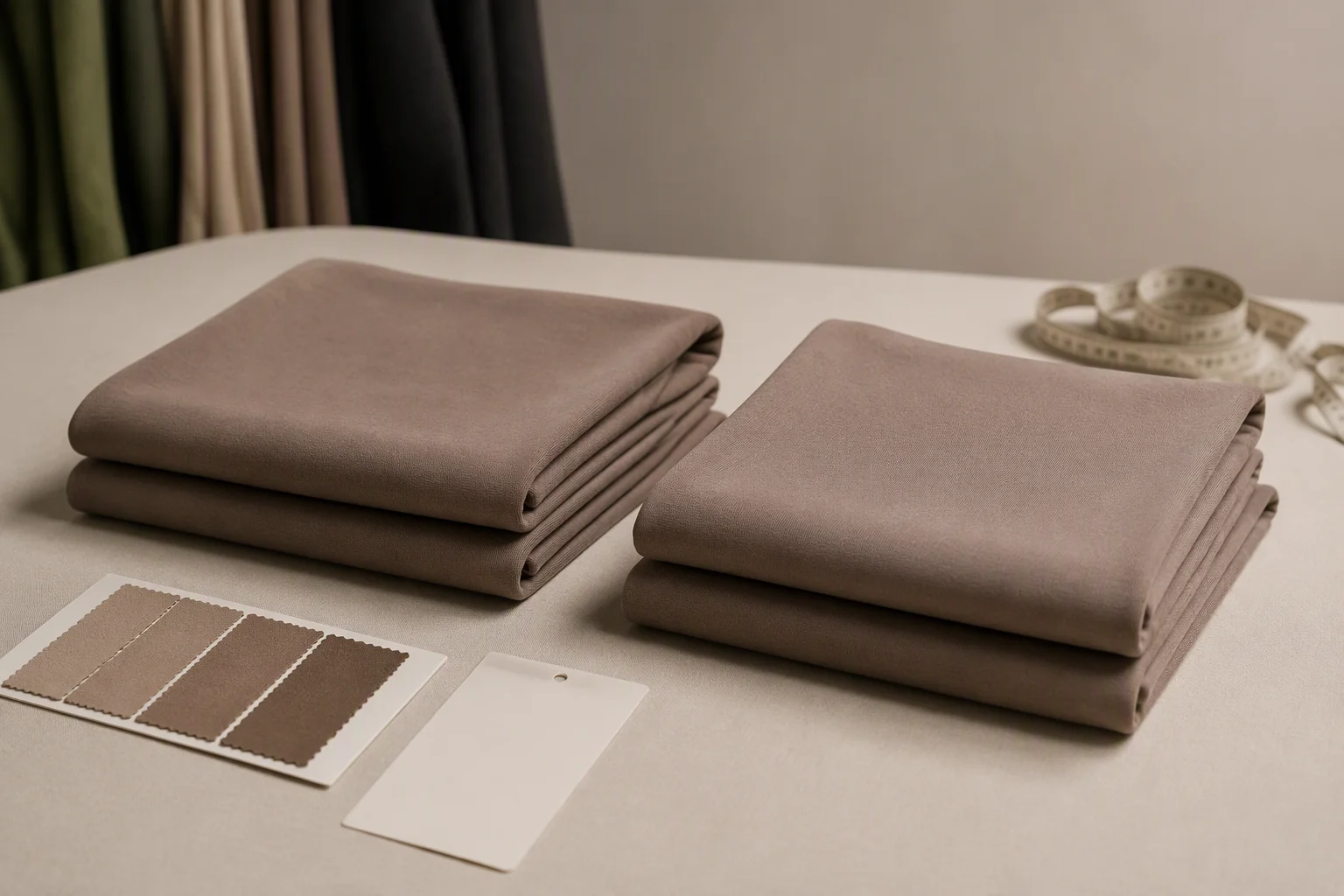
For a wholesale buyer, the first order is only a test. The real business is the reorder — and the reorder after that. A brand builds its catalog, its photography, and its customer promise around a specific hijab in a specific shade, and the whole model depends on being able to buy that exact piece again, season after season. The moment a reorder comes back a shade off, a touch thinner, or a different hand, the brand has a problem it cannot photograph its way out of: customers notice, matching sets stop matching, and trust in the supplier erodes.
Lot-to-lot consistency is therefore one of the most commercially important things a factory does, and one of the least discussed. It is not glamorous, but it is what turns a one-time transaction into a multi-year supply relationship. This guide explains how consistency is actually engineered — the references a factory must retain, the tolerances that define a match, and the controls that reproduce fabric weight, color, hand, and size across every lot.
Part 1: Why lots drift in the first place
To control variation you have to understand where it comes from, because consistency is really the discipline of removing avoidable drift.
Dyeing is chemistry, not printing. Each dye lot is a separate chemical batch. Water, temperature, dye concentration, and time all vary slightly, and those small differences shift the final shade. Two lots dyed to the same recipe on different days will not be identical unless they are both matched back to a fixed standard.
Fabric batches vary. Yarn comes in production lots too. Fiber from a different spinning batch can take dye marginally differently or knit to a slightly different density, nudging both color and GSM.
Memory is not a specification. The biggest cause of drift is informal reordering — 'make it like last time' with no retained reference. Without a physical master and recorded recipe, 'last time' is a moving target, and each order drifts a little further from the original.
Compounding. When each reorder is matched to the previous one rather than to a fixed origin, errors stack. Lot three matches lot two, lot two matched lot one, and by lot five the color has visibly wandered. The fix is to always match to a single retained standard, never to the last batch.
Part 2: The master references we retain
Consistency starts with keeping the right physical and digital anchors, so that every future order is produced against the origin rather than against guesswork.
Master color standard. At first approval we lock the color as both a lab dip (the dyed fabric swatch the brand signs off) and a numerical reading. This becomes the permanent reference for every future lot.
Shade band. No dye process hits a single point exactly, so we agree a shade band — a defined acceptable range around the target, typically bounded at ΔE 1.0. A lot inside the band passes; outside, it is redyed or rejected. The band makes 'a match' objective rather than a matter of opinion.
Sealed production sample. A sealed piece from the approved production run is retained as the physical benchmark for hand, drape, finish, and opacity, not just color.
Fabric specification. Fiber content, GSM target with tolerance, and cover factor are recorded so the base cloth is reproduced, not just the color on top of it.
Batch records and dye recipe. The dye recipe and per-lot GSM readings are filed, so a reorder is built from documented parameters.
Together these turn a reorder from an act of memory into an act of reproduction.
Part 3: The tolerances that define a match
A 'match' has to be a number, not a feeling, because without agreed tolerances every borderline lot becomes an argument. We work to a clear set.
Color: ΔE 1.0. ΔE is the standard measure of color difference between two samples. A ΔE of 1.0 is around the threshold most people cannot perceive, so holding every lot to within 1.0 of the master standard means customers see one consistent color across orders.
Weight: GSM +/- 5%. Fabric weight is held within 5% of the target GSM. This keeps the hand and opacity stable — a reorder will not suddenly feel thinner or read more see-through.
Dimensions: +/- 2 cm. Finished size is held to +/- 2 cm on standard squares, so a reorder drapes and folds the same and fits any packaging or matching-set program.
Hand and finish: against the sealed sample. Softness, drape, and surface finish are judged against the retained production sample, so the subjective qualities stay anchored too.
Agreeing these tolerances in the tech pack up front is what lets both sides resolve any question objectively, by measurement rather than by debate.
Part 4: How we hold consistency in production
Retained references only help if production is actually matched to them, so the controls run through every stage of a reorder.
Dye-to-standard, every lot. Each new lot is dyed and then matched to the master standard under controlled lighting, not to the previous shipment. Lots outside the shade band are corrected before they proceed.
Incoming fabric GSM check. Knitted fabric is checked against the GSM target before cutting, so an out-of-spec base cloth is caught at the roll.
Controlled light assessment. Color matching is done in a standardized light booth, because a shade that matches under warm light can mismatch under daylight — assessing under a fixed light source removes that trap.
In-line monitoring. Density and shade are monitored during the run so drift is caught mid-production, not at the end.
AQL 2.5 final inspection. The finished reorder is inspected to AQL 2.5 (Acceptance Quality Limit, the statistical sampling standard that sets how many defective pieces are tolerable in a batch), with color against the master standard and GSM against target as part of that inspection.
These steps are routine, but routine is exactly the point: consistency comes from doing the same controlled process every time.
Part 5: What the brand should do to protect consistency
Consistency is a shared responsibility, and a few habits on the brand side make reorders far more reliable.
Approve a proper shade band, not just a photo. Sign off a physical lab dip and agree the band. A color approved from a screen cannot be reliably reproduced because screens vary.
Lock core colors to standing standards. For the shades a brand rebuys constantly, keep them on a fixed standard and, where possible, a standing fabric quality, so reorders skip re-development entirely.
Reorder against the style code, not a new brief. Reference the original approved style and its retained standard on every reorder, so the factory produces against the anchor rather than reinterpreting a fresh description.
Keep your own retained sample. Hold a sealed piece from each approved order on the brand side too, so both parties can check a reorder against the same physical origin.
Plan core-color dye runs. Brands with steady demand can schedule periodic dye runs of core shades, which both speeds reorders and improves consistency by batching the same recipe.
When the brand and the factory both anchor to the same references, reorders stop being a gamble.
Part 6: Common consistency failures and how we design them out
Most reorder complaints trace back to a short list of avoidable scenarios, and naming them helps a brand brief precisely.
Matching to the last shipment instead of the origin. The classic compounding error. We design it out by always dyeing to the retained master standard, so lot ten is matched to the original, not to lot nine.
Approving color on a screen. A shade signed off from a photo or monitor cannot be reproduced reliably because displays vary. We require a physical lab-dip approval and keep it on file.
No retained sample on either side. If neither party kept a sealed piece, 'it looks different' becomes impossible to adjudicate. We retain a sealed production sample and recommend the brand does too.
Fabric substitution on reorder. Quietly swapping to a different yarn or knit batch to save cost shifts hand and GSM. We reorder against the recorded fabric specification, and any proposed change is flagged to the brand first, never made silently.
Mixed lots in one shipment. Shipping two dye lots in a single order can put visibly different pieces side by side. We segregate and label lots and check cross-lot shade so a single shipment reads as one color.
Each of these is cheap to prevent at setup and expensive to discover after a brand has shipped mismatched product to its own customers. The pattern across all of them is the same: consistency fails whenever an order is produced from an informal description instead of a retained reference, and it holds whenever the origin standard is the single source of truth. A supplier that can show you its retained-standard process is telling you how your fifth reorder will look, not just your first.
Part 7: Why consistency is a growth lever, not just a QC task
It is tempting to see lot-to-lot control as a defensive, behind-the-scenes concern, but it directly enables the things that grow a modest-fashion brand.
Reliable catalog photography. When every reorder matches, a brand shoots a color once and trusts the image for years, instead of reshooting as shades drift.
Viable matching sets. Three-piece color families and coordinated sets — a popular, high-margin retail format — only work if the pieces match across orders and the set reads as curated.
Confident restocking. A brand can promise 'back in stock' in the exact shade customers loved, turning a sell-out into a repeat sale rather than a disappointment.
Lower returns. Customers who rebuy a color they already own expect it to match what they have; consistency keeps those repeat purchases from coming back as returns.
Supplier stickiness. For the factory, consistency is what earns the multi-year relationship. A brand that can rely on identical reorders has little reason to risk switching suppliers.
Seen this way, the retained standards, shade bands, and tolerances are not overhead — they are the infrastructure that lets a brand scale a proven product with confidence.
Conclusion
The first order proves a product; consistent reorders build a business. Lot-to-lot consistency is engineered, not hoped for: it comes from retaining a master color standard and sealed sample, agreeing a shade band and clear tolerances (ΔE 1.0 on color, +/- 5% on GSM, +/- 2 cm on size), dyeing every lot to the fixed standard rather than the last shipment, and inspecting to AQL 2.5 against those anchors. Set that up at first approval and a brand can rebuy the exact same hijab a year later and have it match.
QiuYan Factory maintains retained standards, shade bands, and batch records for modal, jersey, bamboo viscose, and Tencel Lyocell hijabs so DTC brands, boutiques, and OEM/ODM buyers across Europe, the Gulf, and North America can reorder with confidence. To set up consistent reordering for your core range, email melody@wennuanfactory.com or message WhatsApp +86 150 2459 7603.
Frequently Asked Questions
Why does the same hijab color look different between my first order and my reorder?
Almost always because the two orders came from different dye lots without a controlling reference. Dyeing is a chemical process, and separate lots naturally drift slightly in shade unless they are matched back to a fixed standard. The fix is a shade band and a retained master sample: your approved color is kept as the physical and numerical reference, and every future lot is matched to it within ΔE 1.0 rather than to the previous batch. Without that anchor, small drifts compound order after order. We set this up at first approval. Email melody@wennuanfactory.com or WhatsApp +86 150 2459 7603.
What exactly do you keep on file so a reorder matches the original?
For every approved style we retain: the master color standard (lab dip plus a physical swatch), the approved shade band (the acceptable tonal range around the target), a sealed production sample, the fabric specification (fiber, GSM, cover factor), and the batch records including per-lot GSM readings and dye recipe. A reorder is produced against those retained references, not from memory, so the fabric weight, hand, color, and dimensions reproduce. This is what lets a brand rebuy the same shade a year later with confidence.
How much variation is normal between lots, and what is a defect?
A small, controlled variation is physically unavoidable in textiles; the question is whether it stays inside the agreed tolerance. We hold color to ΔE 1.0 against the master standard (a difference most people cannot see), GSM to +/- 5% of target, and finished dimensions to +/- 2 cm. Within those bands, lots are considered a match. Outside them, it is a defect we catch at inspection before shipment under AQL 2.5. Agreeing these tolerances up front is what separates 'close enough' arguments from an objective pass/fail.
Ready to Order