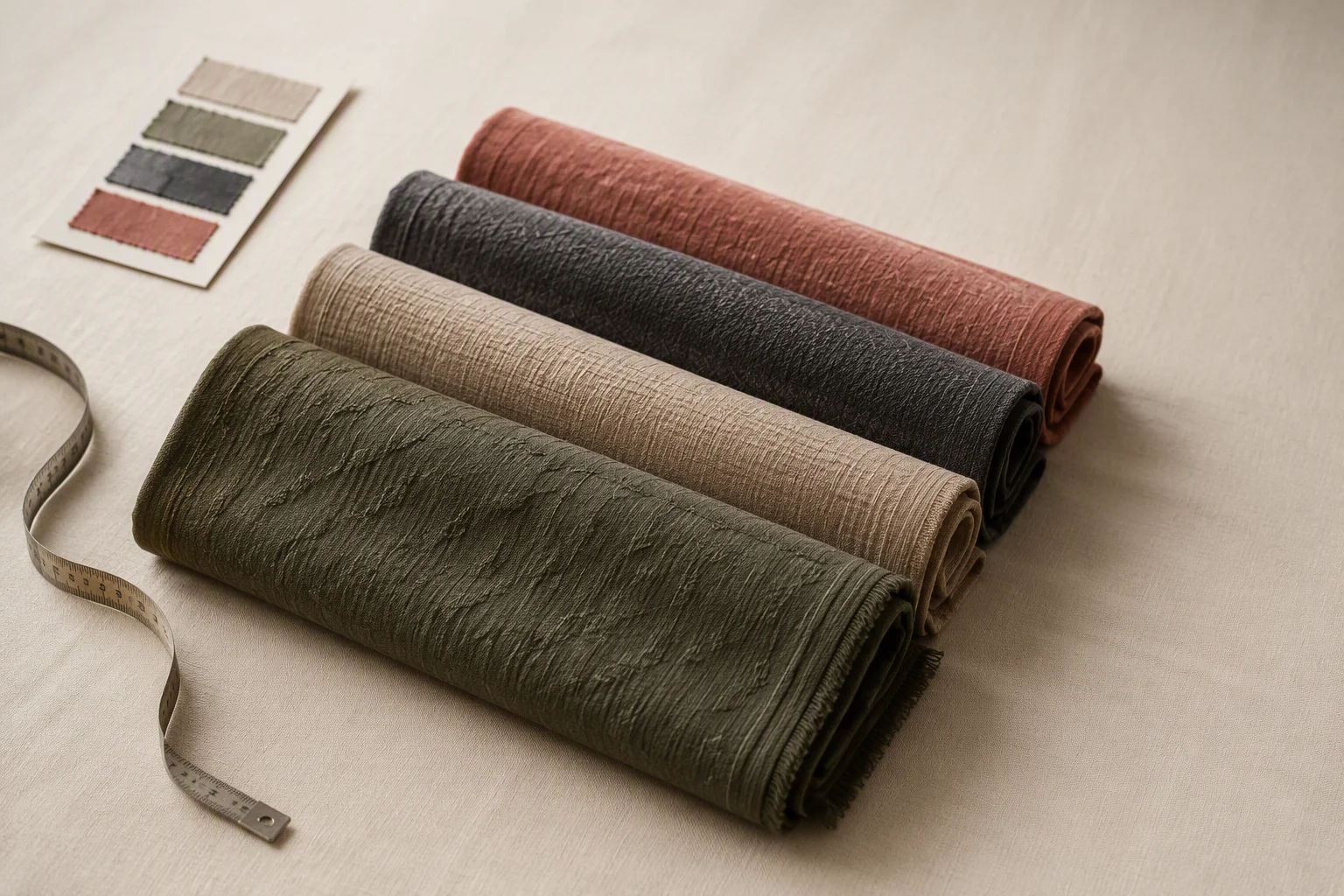
Executive Summary: Why Texture Is Replacing Loud Print
The commercial modest-fashion buyer is not abandoning color. The shift is more precise: many premium collections are using a narrower color palette and allowing fabric surface, drape and finishing to create the visual distinction. Monochrome styling, tonal layering and quiet-luxury merchandising give a DTC brand a cleaner product system, easier cross-selling and a more consistent image library.
For a hijab manufacturer, this changes the brief. A plain black or sand scarf is no longer automatically a simple product. A buyer may expect the same color family across a smooth modal base, a subtle dobby stripe, a jacquard geometric texture and a matching under-cap. If the shade is inconsistent, or if the texture becomes harsh after finishing, the collection loses the premium effect.
This guide explains how to source monochrome textured hijabs for private-label collections. It covers surface construction, color approval, print and dye decisions, dimensional tolerances, snag testing, quality inspection and commercial planning. The objective is not to make unsupported luxury claims. It is to give a buyer a factory-side checklist that can be written into a purchase order.
---
1. Define the Monochrome Brief Before Choosing the Fabric
鈥淢onochrome鈥?should describe a controlled color system, not simply one color. A useful brief separates four decisions:
1. Base shade: the approved color reference, such as warm ivory, olive, charcoal or muted terracotta.
2. Surface contrast: whether texture is tone-on-tone, created by weave relief, or created by a small difference in luster.
3. Collection depth: whether the buyer needs one hero shade, three tonal shades or a complete seasonal palette.
4. Styling function: whether the scarf is an everyday core item, a capsule accent, a formal piece or a matching-set accessory.
For each shade, the factory should receive a physical standard or a recognized color reference. A screen image is not sufficient for bulk approval because display brightness, color temperature and browser settings can change the visual result. The production file should identify the fiber content, target weight, finished size, edge finish and approved light source for color evaluation.
A monochrome program benefits from a color-control matrix. The matrix can list the base fabric, textured fabric, printed version, under-cap and packaging label. The buyer then sees where the same shade is required and where a deliberately lighter or darker tonal step is acceptable. This prevents a common error: treating all products as if they should match exactly when the collection actually needs controlled contrast.
---
2. Jacquard, Dobby and Embossed Effects
Jacquard texture
Jacquard construction uses selected warp and weft intersections to create a motif inside the woven structure. On a modal hijab, it can create a tonal geometric, botanical or micro-check surface without adding a separate printed layer. The advantage is depth: the motif remains visible when the scarf is folded or viewed from different angles.
The buyer should request a loom sample before approving a large color run. Review the reverse side, float length, edge behavior and hand feel. Excessive floats can catch on pins or jewelry. For a lightweight scarf, keeping exposed floats short and testing the surface with the actual magnetic pin or brooch used by the brand is more useful than judging a loose swatch alone.
Dobby construction
Dobby looms create smaller repeating structures, such as fine ribs, dots and compact geometric effects. Dobby is often suitable when a buyer needs a modest texture with a simpler repeat and a lower development burden than a complex jacquard. It can also support a core-color program where one base fabric is offered in several shades.
The key risk is texture flattening. Excessive heat, pressure or aggressive finishing can reduce the relief that gives the fabric its value. The purchase specification should therefore state the acceptable texture appearance after washing, not only the appearance of the greige or unfinished cloth.
Embossed or calendered effects
A surface effect can also be produced through finishing rather than weaving. This route may be efficient for a limited capsule, but the effect can relax after washing. Ask the factory to compare the pre-wash and post-wash appearance, record the finishing route and confirm whether the effect is permanent, semi-permanent or expected to soften.
---
3. Color Matching on Textured Surfaces
Color matching a flat modal swatch is not the same as matching a textured hijab. Raised areas catch more light, recessed areas appear darker and the direction of the fold changes perceived saturation. For this reason, a professional approval process uses three references:
- a flat fabric swatch;
- a finished scarf with the selected edge treatment;
- a folded and draped sample viewed under the agreed light source.
Delta E control
Delta E is a numerical description of perceived color difference between a target and a sample. For a premium monochrome program, the buyer and factory should agree on the color formula, measurement method and tolerance before bulk dyeing. A practical factory target is Delta E 2000 of 1.5 or lower for a smooth surface, with any exception documented for a textured or heathered construction.
The number does not replace visual review. A spectrophotometer can confirm a reading, but it does not tell the buyer whether the surface texture looks too bright, too flat or too metallic. Record both the instrument result and the visual approval under a standard light box. Keep the approved lab dip and bulk-production reference together in the inspection file.
Dye-lot discipline
Monochrome collections are sensitive to dye-lot variation because small differences become visible when two scarves are styled together. Whenever possible, produce one color in a controlled dye lot and identify the roll numbers used for sampling and bulk production. If a repeat order uses a new lot, send a new shade band or finished sample rather than assuming the previous approval transfers automatically.
---
4. Printing Over Texture: When It Works and When It Does Not
A quiet-luxury collection does not need to be entirely solid. A tonal digital print over a jacquard or dobby base can create depth, but the design must respect the structure underneath. Fine lines may break over raised motifs, and dense ink coverage can make a soft fabric feel stiffer.
For a tonal print program, the technical team should check:
1. Registration: the motif must remain aligned with the texture repeat.
2. Ink load: excessive ink can reduce softness and drape.
3. Reverse appearance: confirm whether the collection needs visible color on both sides.
4. Wash response: test the texture and color together after the agreed wash cycle.
5. Edge behavior: confirm that the hem does not create a darker or heavier line around the design.
For everyday modal, a restrained digital reactive print can work well when the artwork uses one base shade and one tonal step. The factory should provide a strike-off, which is a small printed approval sample, before bulk printing. Do not approve only from a digital screen proof.
---
5. Weight, Drape and Dimensional Tolerances
For a lightweight textured modal hijab, an initial development range of 60鈥?0 GSM is practical, depending on opacity, weave density and desired drape. A heavier construction may improve body, but it can also increase warmth and reduce the fluid movement expected from modal. The correct weight is the one that supports the intended styling and remains comfortable during long wear.
Finished dimensions should be written with tolerances. A standard rectangular scarf may be specified as 180 脳 70 cm, 195 脳 75 cm or another agreed size. A practical starting tolerance is 卤1.0 cm on finished length and width, with the buyer confirming whether the tolerance applies before or after washing. The factory should also record skew, bowing and shrinkage.
A textured weave can relax differently from a plain weave. Measure the sample before wash, after wash and after conditioning. If the design has a directional stripe or border, check that the border remains visually parallel to the edge. A technically acceptable length is not enough if a geometric border appears visibly tilted when the scarf is folded.
---
6. Snagging, Pilling and Edge Testing
Texture adds visual value but can create additional contact points. Test the finished scarf with the accessories customers will actually use: magnetic pins, brooches, rings and under-caps. Inspect for pulled yarns, broken filaments and surface fuzz after repeated handling.
A factory quality plan can include:
- visual inspection under consistent lighting;
- a pin-contact test on the highest-relief section;
- pilling observation after the agreed laundering cycle;
- edge inspection for skipped stitches, loose tails and uneven roll width;
- color comparison against the approved standard;
- dimensional measurement and skew evaluation.
For the edge, a 1.0鈥?.5 mm baby rolled hem can provide a precise commercial finish when the fabric is stable enough for machine handling. A hand-rolled hem may suit a limited luxury line, but the buyer should budget additional labor and allow a longer production calendar. The edge specification should state the target width, stitch density and acceptable visual variation.
AQL 2.5 is an inspection sampling framework, not a promise that every individual item has zero defects. The buyer and factory should define the defect list before inspection: critical, major and minor defects; measurement points; color criteria; and packaging requirements.
---
7. Private-Label MOQ, Sampling and Packaging
A monochrome textured collection is easier to scale when the brand separates development quantity from production quantity. A factory may be able to produce one or a few development samples, while the final MOQ depends on the loom, dye lot, color count and packaging program.
For a standard textured modal program, a practical commercial plan can be structured as follows:
- **Development sample:** one finished piece per colorway, normally 5鈥? business days after artwork and fabric selection.
- **Color approval:** lab dip or strike-off approval before bulk dyeing or printing.
- **Bulk MOQ:** commonly 100 pieces per color for a standard private-label program; custom loom development requires a separate quotation.
- **Bulk lead time:** approximately 15鈥?0 working days after approvals, depending on construction and order quantity.
- **Packaging:** woven label, care label, barcode sticker, paper card and recyclable polybag or box according to the brand brief.
Use one packaging specification sheet. It should show the label position, folded dimensions, barcode data, carton marking, polybag warning requirements and master-carton quantity. A premium fabric can lose its intended positioning if the packaging compresses the texture or creates permanent fold marks.
---
8. Buyer Checklist for a Quiet-Luxury Hijab Program
Before confirming a purchase order, ask the factory to document:
1. Fiber composition and target GSM with tolerance.
2. Weave construction, motif repeat and float-risk control.
3. Approved physical color standard and Delta E method.
4. Finished size, shrinkage, skew and border alignment.
5. Edge finish, target width and stitch-density requirement.
6. Snag, pilling, wash-fastness and color-fastness test plan.
7. AQL 2.5 inspection level and defect classification.
8. Sample, approval and bulk-production milestones.
9. Private-label packaging artwork and carton specification.
A clear brief lets the factory quote the same product that the brand intends to sell. It also prevents the most common sourcing failure: comparing two prices that represent different fabrics, different finishing levels or different quality-control expectations.
For a monochrome textured hijab development, send your target color reference, preferred weave, finished dimensions and packaging brief to our technical team. Request a physical strike-off before confirming the bulk order.
- **Direct Factory Email:** [melody@wennuanfactory.com](mailto:melody@wennuanfactory.com)
- **B2B WhatsApp:** [+86 150 2459 7603](https://wa.me/8615024597603?text=Hello%20QiuYan%20Factory%2C%20I%20am%20interested%20in%20a%20monochrome%20textured%20hijab%20private-label%20program.)
QiuYan Factory supports private-label hijab development for DTC brands, boutique buyers and OEM/ODM sourcing teams that need controlled materials, consistent color and documented production standards.
Frequently Asked Questions
What Delta E tolerance should a brand specify for a monochrome hijab collection?
For a repeatable private-label collection, specify Delta E 2000 of 1.5 or lower between the approved lab dip and bulk production under the agreed D65 light source. A tolerance up to 2.0 may be commercially acceptable for textured or heathered surfaces, but the buyer should approve both a flat swatch and a finished scarf because jacquard relief changes perceived lightness.
Which construction is better for a quiet-luxury textured hijab: jacquard or dobby?
Dobby is usually the efficient choice for a small geometric texture with a lower development burden, while jacquard is better when the brand needs a more complex tonal motif or a reversible surface. For 60鈥?0 GSM modal, keep relief moderate and validate snag resistance with magnetic pins before approving bulk production.
What MOQ and lead time should a private-label buyer plan for a monochrome textured hijab?
A practical starting structure is 100 pieces per color for a standard texture, with digital sampling in 5鈥? business days and bulk production in 15鈥?0 working days after the approved sample, artwork, color standard and packaging specification are signed off. Custom jacquard programs may require a separate loom-development quotation and a longer pre-production calendar.
Ready to Order