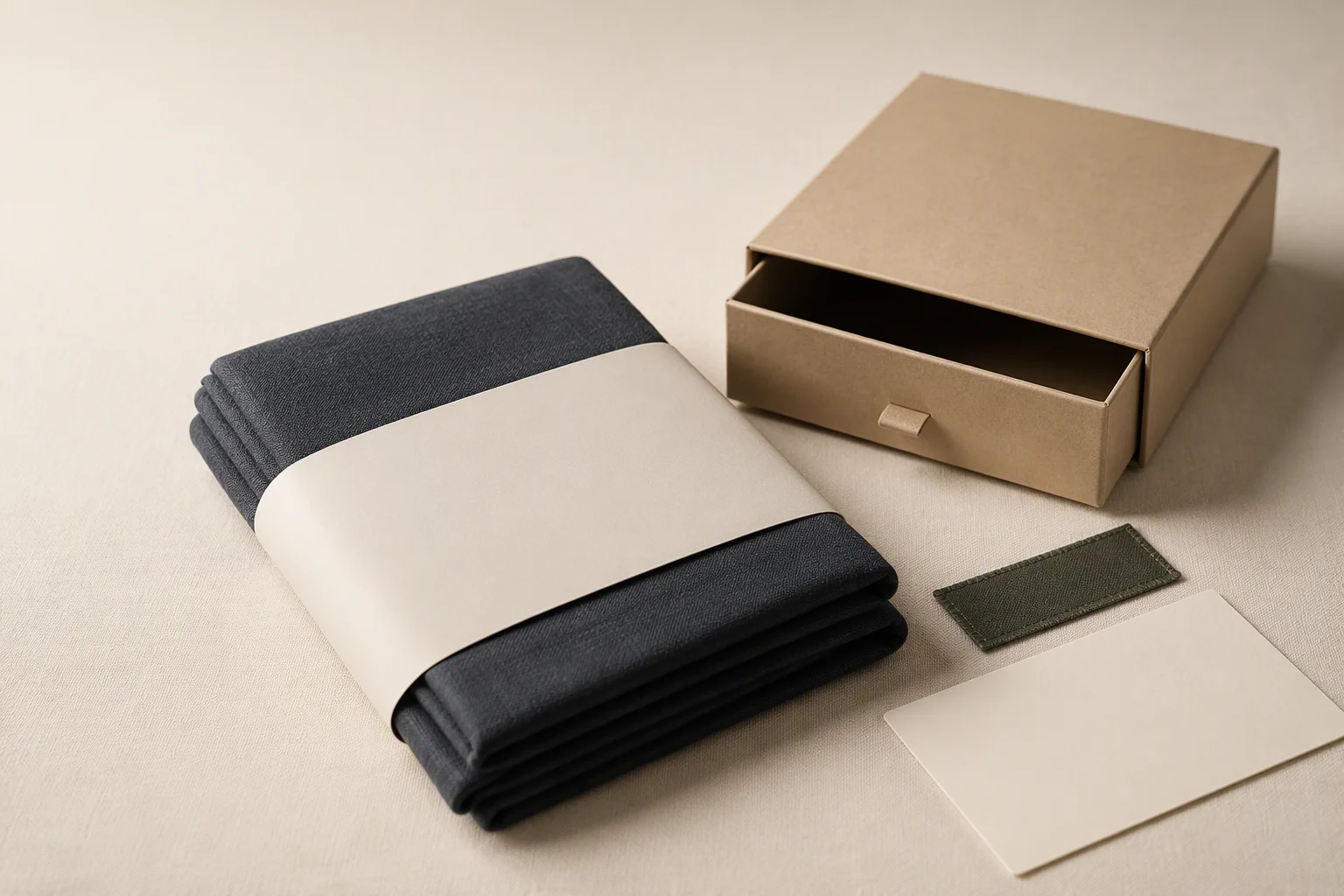
Executive Summary: Packaging Is Part of the Product Specification
A private-label hijab program is not complete when the fabric passes inspection. The buyer must also receive the correct label, folded presentation, barcode, carton marking and documentation. A soft modal scarf with the wrong fiber declaration can create a compliance problem. A correctly sewn label inside the wrong SKU can create a warehouse problem. A carton with missing shipping marks can create a receiving delay.
For DTC brands, boutique buyers and OEM/ODM purchasing teams, packaging is the final handoff between factory production and customer experience. It communicates how the product should be cared for, verifies what was ordered and gives the logistics team the information needed to identify the shipment.
This guide explains how to build an export-ready private-label packaging program for hijabs. It focuses on practical factory controls: artwork approval, fiber and care information, label placement, packaging material selection, sustainability wording, barcode and carton control, AQL 2.5 inspection and shipment traceability.
The goal is not to add unsupported marketing promises. It is to create a clear, documented packaging system that matches the physical product and the buyer's destination market.
---
1. Start With a Packaging Bill of Materials
Before sampling, create a packaging bill of materials (BOM). A BOM is the controlled list of packaging components assigned to a product. For one hijab SKU, it may include:
1. Main brand label.
2. Fiber and care label.
3. Hangtag or product card.
4. Folded paper sleeve, glassine envelope or recyclable polybag.
5. Barcode sticker or printed barcode.
6. Carton label and shipping mark.
7. Master-carton packing list.
Each component should have a reference code, artwork revision, material, size, placement and approval date. If the brand has several colors or collections, the BOM should show whether the component is shared across all products or specific to one SKU.
This matters because packaging errors are often version errors. A factory may have the correct new logo label and an older care label in the same production room. A controlled BOM gives the production and QC teams one source of truth.
The buyer should approve a physical packaging sample, not only a PDF. Paper thickness, folding pressure, label softness and the amount of compression applied to a textured scarf can change the unboxing result.
---
2. Fiber Composition and Care Information
The fiber declaration must describe the actual product. If a scarf is 95% modal and 5% spandex, the packaging and label should not describe it as 100% modal. If a product uses a viscose-based fiber, the exact approved wording should be checked against the buyer's market requirements and supplier documentation.
A factory should verify five items before label production:
- fiber percentages;
- finished product category;
- care method and temperature;
- country-of-origin wording;
- language and placement requirements for the destination market.
The care label should reflect the tested product, not a generic template. A printed modal scarf and a jacquard modal scarf may need different care instructions if their surface construction, color process or dimensional stability differs. The buyer should confirm whether machine washing, hand washing, line drying or low-temperature ironing is supported by the actual test result.
If the product has a delicate hand-rolled silk edge, the care instruction should protect that edge. If the product has a textured surface, the instruction should avoid wording that implies aggressive tumble drying is acceptable unless it has been validated.
Label readability and durability
Text must remain readable after sewing, folding and normal care. A label that is too small becomes difficult to scan or read. A label with weak ink or poor thermal transfer can fade before the product reaches the consumer. The factory should check print sharpness, edge cutting, sewing security and label position during inline inspection.
For a standard rectangular hijab, define placement from a fixed edge, such as a measured distance from the hem corner. This makes the label repeatable across production lots and avoids a visibly inconsistent brand position.
---
3. Brand Labels, Hangtags and Product Identity
A brand label is a product identifier, not a substitute for a fiber and care label. The two functions should be separated unless the buyer's approved layout specifically combines them.
Woven labels provide a durable identity mark, while printed satin or recycled polyester labels can support a softer hand feel. For a lightweight hijab, the buyer should test whether the label creates a bulky area or irritates the skin when the scarf is styled close to the face. Label backing, folded edges and stitch count all influence comfort.
Hangtags should carry only approved information. Common fields include the brand name, product name, color name, size, barcode, country of origin and a short care reminder. Do not place a certification logo, recycled claim or origin statement on a hangtag unless the brand has the required permission or evidence for that specific claim.
Use one artwork revision for each approved component. The artwork file name should include the SKU or shared component code, revision number and approval date. The factory should remove obsolete artwork from the active production folder or clearly mark it as obsolete to prevent accidental mixing.
---
4. Sustainability Claims: Evidence Before Wording
Packaging is a high-visibility place for sustainability language, which makes unsupported wording especially risky. A buyer may know that a fiber is plant-derived, but that fact alone does not prove that the finished product is biodegradable, compostable or produced under a specific certified chain of custody.
Build a claim matrix with three columns:
1. Proposed wording: what the brand wants to print.
2. Evidence: the test report, certificate, supplier declaration or chain-of-custody document supporting it.
3. Permitted placement: packaging, product page, hangtag or internal documentation.
If evidence is not available, use a precise material description instead of a broad environmental promise. For example, naming the verified fiber composition is safer than calling the whole product 鈥渆co-friendly.鈥?If packaging is made from recycled paper, retain the supplier specification and define whether the claim refers to pre-consumer or post-consumer content.
The factory can prepare packaging prototypes with blank areas while the buyer completes its claim review. This avoids printing a large quantity of boxes that later need to be destroyed because one unsupported sentence must be removed.
---
5. Paper, Polybag and Box Selection
Packaging should protect the product without changing its finished appearance. A textured or brushed hijab can develop permanent compression marks if it is tightly folded under excessive pressure. A silk chiffon scarf can catch on rough paper edges. A soft modal scarf can absorb odor from unsuitable packaging materials.
Paper sleeve
A paper sleeve gives a clean retail presentation and can be specified in different weights and finishes. Confirm the internal dimensions after the scarf is folded to the approved size. The sleeve should hold the product securely without crushing it. Test the closure and edge finish for snagging.
Glassine or recyclable film bag
A transparent or semi-transparent bag allows the buyer to identify the color while protecting the fabric during transit. The material and disposal wording must match the actual packaging material. Do not print a compostable claim on packaging that has not been documented as compostable under the intended disposal conditions.
Rigid drawer box
A rigid box can support premium positioning, gifting and seasonal capsule drops. It also increases packing volume and freight cost. The buyer should calculate the packed cubic volume and master-carton quantity before approving the box. A beautiful package that doubles the carton volume may be unsuitable for a wholesale program.
Carton construction
Master cartons should protect the packed units from compression and humidity. Define carton dimensions, board strength, inner protection, gross-weight limit and stacking requirements. Carton marks should be legible from the receiving side of the shipment and should match the commercial packing list.
---
6. Barcode and SKU Control
A barcode is useful only when its data matches the product and the buyer's inventory system. Before printing, the buyer should confirm the SKU code, color code, size code, barcode type and human-readable number. The factory should scan a physical sample rather than relying only on the artwork preview.
For each packed SKU, perform a line clearance check:
- remove the previous SKU label from the workstation;
- load only the approved label and packaging version;
- scan the barcode against the production list;
- compare the color name and product description;
- record the carton quantity;
- photograph the first approved packed unit.
The same control applies when one scarf is offered in several shades. A similar-looking olive and khaki label can cause downstream stock errors even when the fabric itself passes inspection.
A master carton should not contain mixed SKUs unless the buyer has approved the arrangement. If mixed cartons are required, the packing list must show the quantity of each SKU and the carton number associated with it.
---
7. AQL 2.5 Inspection for Packaging and Product Matching
AQL 2.5 is an acceptance quality limit sampling framework used to define how many pieces are inspected and how many defects may be accepted within the sample. It does not replace a defect list or product-specific inspection plan.
For a private-label hijab shipment, the inspection should include both product and packaging defects:
Product defects
- wrong fiber or color version;
- incorrect finished size beyond the agreed tolerance;
- skipped stitches, open seams or uneven hem;
- visible stain, hole, oil mark or pulled yarn;
- texture distortion or border misalignment.
Packaging defects
- wrong label revision;
- unreadable care information;
- missing barcode or wrong barcode;
- incorrect color name;
- damaged sleeve, box or carton;
- wrong unit count or carton marking.
The buyer and factory should define critical, major and minor classifications before the inspection date. A missing safety-related label may require a different classification from a small cosmetic crease in an outer sleeve. The inspection report should record the sample size, defect counts, photographs, carton numbers and final decision.
---
8. Export-Ready Timeline and Factory Handoffs
Packaging should enter the production calendar early enough to avoid delaying shipment. A practical sequence is:
1. Confirm product tech pack, label wording and packaging BOM.
2. Prepare physical fabric and packaging samples.
3. Approve color, size, care text, barcode and artwork revisions.
4. Produce one packed reference unit per SKU.
5. Start bulk product and packaging production after written approval.
6. Conduct inline checks for labels and packaging version.
7. Complete final product and packaging inspection under the agreed AQL plan.
8. Photograph packed cartons and issue the packing list.
For a standard private-label hijab program, development samples can usually be planned in 5鈥? business days after the required inputs are complete. Bulk production may take 15鈥?0 working days after sample, artwork, color and packaging approval, depending on the construction and order quantity. Custom boxes, special woven labels or new barcode systems may require additional development time.
The final handoff should include the approved packaging artwork, product specification, inspection report, packing list and shipment photographs. These records allow a brand to investigate a receiving discrepancy without relying on memory.
---
9. Buyer Checklist Before Approving Bulk Packaging
Before releasing the purchase order, confirm:
1. The fiber declaration matches the approved product composition.
2. Care instructions match the tested fabric and edge finish.
3. Country-of-origin wording and destination-market requirements have been reviewed.
4. The brand label, care label and hangtag versions are controlled.
5. Sustainability wording is supported by product-specific evidence.
6. Barcode data scans correctly and matches the SKU list.
7. Folded dimensions do not compress or damage the scarf.
8. Carton dimensions, quantities, marks and weights are approved.
9. AQL 2.5 product and packaging defect classifications are documented.
10. The final packed reference unit is retained by both buyer and factory.
A precise packaging brief reduces rework, protects the customer experience and makes the shipment easier to receive. It also gives the factory a clear definition of what 鈥減rivate label ready鈥?means for the specific brand.
For a private-label packaging quotation, send the product list, label artwork, packaging preference, barcode information and target market to our technical team:
- **Direct Factory Email:** [melody@wennuanfactory.com](mailto:melody@wennuanfactory.com)
- **B2B WhatsApp:** [+86 150 2459 7603](https://wa.me/8615024597603?text=Hello%20QiuYan%20Factory%2C%20I%20am%20interested%20in%20private-label%20hijab%20packaging%20and%20OEM%20production.)
QiuYan Factory supports private-label hijab production, packaging coordination and OEM/ODM sourcing for DTC brands, boutique buyers and wholesale programs.
Frequently Asked Questions
What information should a private-label hijab care label contain?
The label should match the approved fiber composition, care symbols, country-of-origin requirement, brand identity and buyer-market rules. The factory should verify the text against the approved tech pack before sewing and should keep a signed artwork version with the bulk inspection file.
How can a brand avoid unsupported sustainability claims on hijab packaging?
Separate verified material facts from marketing language. State the actual fiber composition and the certification or chain-of-custody evidence available for that specific product. Do not use broad claims such as 'eco-friendly' or 'biodegradable' unless the buyer has documented evidence and the destination-market wording has been reviewed.
What packaging and carton controls should be checked before bulk shipment?
Approve the label artwork, folded product dimensions, packaging material, barcode data, carton markings, master-carton quantity and shipping marks before production. During pre-shipment inspection, check that the correct label and packaging version is paired with each color, size and SKU, and retain photos of the packed cartons for traceability.
Ready to Order