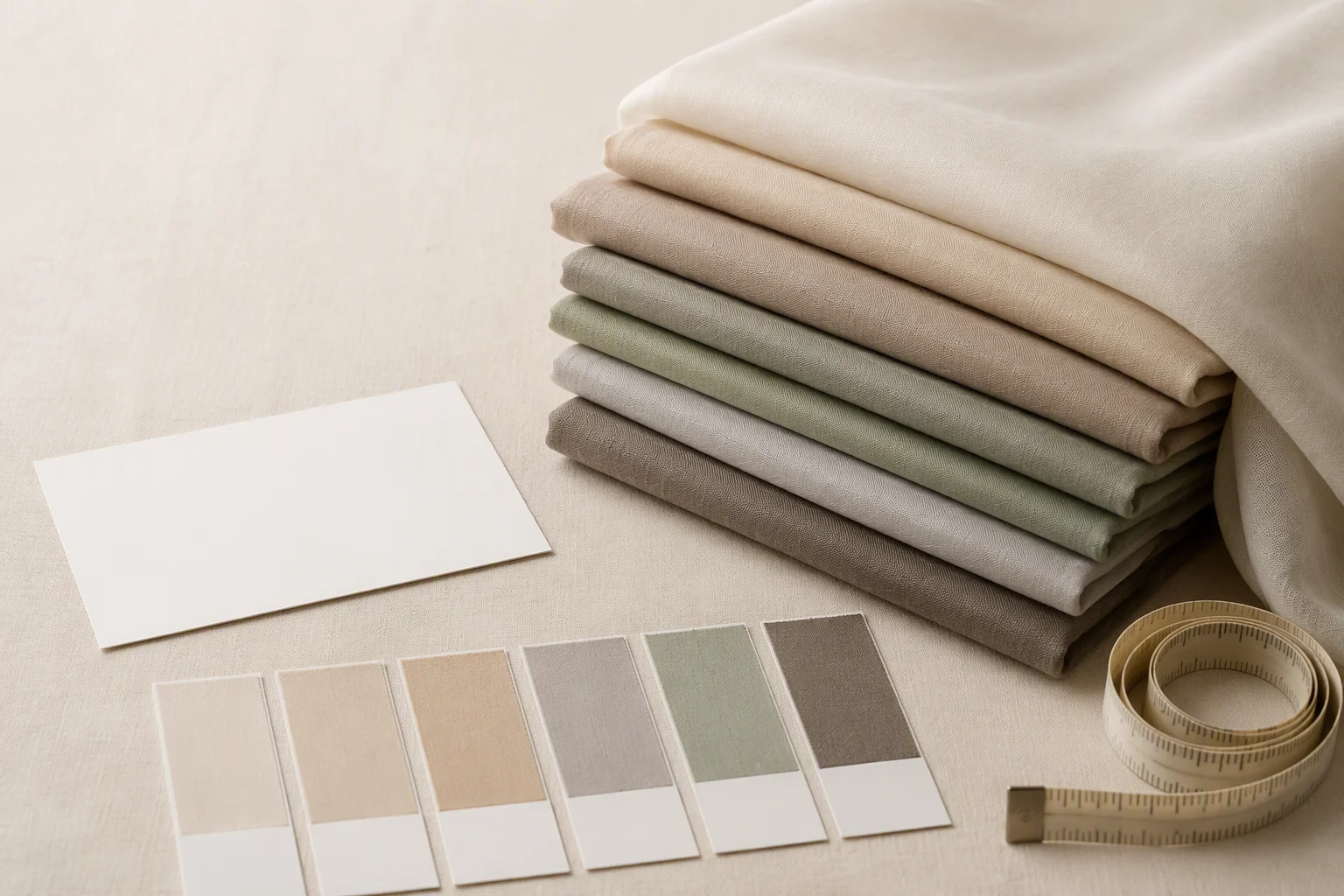
Ramadan 2027: The Calendar That Decides Your Collection
Ramadan is the largest single demand event in the global modest-wear calendar. For DTC brands, boutiques, and private-label buyers across the Gulf, North America, and Europe, this season either funds the year or leaves capital trapped in unsold inventory. Ramadan 2027 is projected to begin around February 6-8, 2027, with Eid al-Fitr falling near March 8-9, 2027. Working backwards from retail shelves, that puts the consumer sell-through window in late January through mid-March 2027 - and it puts your factory purchase order in Q4 2026.
This is a production-floor guide, not a mood board. It covers the four variables that decide whether a Ramadan hijab program lands: breathable lightweight fabric architecture, color architecture and Delta E control, a realistic development calendar, and MOQ plus delivery risk. Every specification below reflects what we actually run at QiuYan Factory, and every number is one you can hold a supplier to.
1. Lead-Time Math: What Actually Sits Between You and the Shelf
Most brands plan the Ramadan collection from the creative side and reverse-engineer production last. That is how collections miss the window. The math is unforgiving:
- Retail set-up and e-commerce launch photography: 3-4 weeks before the sell-through window.
- Bulk production and finishing: 15-20 working days after an approved pre-production sample.
- Sampling, lab dips, and fit iterations: 5-7 business days for the first round, plus 5-7 more per revision cycle.
- Fabric procurement and dyeing, if not held in stock: 10-18 working days.
- Ocean freight to Gulf or EU ports: 25-35 days port to port; air freight 5-8 days at a multiple of the cost.
- Customs clearance and inland distribution: 5-10 days.
Stack those sequentially without overlap and a program that starts fabric in December arrives in March - after Eid. The fix is parallelization and locking decisions early. A disciplined October 2026 start gives you two full sampling revision cycles and still ships container-ready by late January 2027.
2. Breathable Lightweight Fabric: The Engineering Behind 'It Feels Cool'
Ramadan modest wear is worn for long hours, in warm indoor gatherings, and - for Gulf customers - in ambient temperatures that never really drop. Breathability is not a marketing adjective; it is measurable. When buyers ask for a cool-to-the-skin hijab, they are describing four physical properties: low fabric weight, high air permeability, moisture management, and surface smoothness.
GSM targets by construction
- Polyester crepe: 90-110 GSM. The workhorse for draped, structured hijabs. Low wrinkle, excellent color depth.
- Cotton voile: 60-80 GSM. Maximum breathability and a matte, natural surface. Requires tighter control on yarn evenness.
- Poly-cotton voile: 70-85 GSM. Improves hand feel over pure poly while keeping cost accessible.
- Rayon/viscose challis: 85-100 GSM. Soft drape and a premium hand, but dimensionally less stable - control shrinkage tightly.
- Cotton-linen blend: 110-130 GSM. Premium tier with visible texture and strong perceived value.
For a Ramadan collection we typically anchor on 80-110 GSM. Anything above 130 GSM reads as a winter or evening article and defeats the breathability promise; anything below 55 GSM becomes transparent and unstable through repeated washing.
The tolerance sheet you should demand
- Fabric weight: plus or minus 5% of the approved swatch GSM.
- Width: plus or minus 2% on greige and finished goods.
- Dimensional stability after wash: no more than 3% warp and 3% weft.
- Air permeability: 80-200 mm/s (test method ASTM D737), depending on the openness of the weave.
- Color fastness to rubbing: grade 4 minimum; to perspiration: grade 4 minimum.
- pH: 4.0-7.5, a critical skin-safety parameter.
Every one of these is testable and reportable. If a supplier cannot issue third-party or in-house reports for these, the breathable claim is unverifiable.
3. Color Architecture: Building a Palette That Actually Sells
Ramadan color is not one palette. It is at least three overlapping customer stories: the traditional Gulf palette of deep greens, ivory, gold-adjacent neutrals, and black; the trend-forward DTC palette of dusty rose, sage, terracotta, and muted lilac; and the gifting or occasion palette of rich jewel tones, metallics, and tonal whites. A collection that tries to be all three across twelve colorways usually ends up with six that sell and six that age on the shelf.
A practical structure: 60/30/10
- 60% core: 3-4 colorways that repeat every season and are always in stock. Black, ivory, taupe, slate.
- 30% seasonal: 3-4 Ramadan-relevant tones released for the season, developed with fresh lab dips.
- 10% experimental: 1-2 accent or trend colorways, produced at the lowest viable MOQ and treated as a test.
Delta E is the whole game in color
Color is where buyer and factory most often disagree, and it is entirely solvable with numbers. We work to these tolerances:
- Lab dip versus approved standard: Delta E less than or equal to 1.0 (CMC 2:1) - a pass no argument needed.
- Production bulk versus approved lab dip: Delta E less than or equal to 1.5.
- Batch-to-batch within one PO: Delta E less than or equal to 1.0.
- Commercial tolerance with prior written approval: Delta E less than or equal to 2.0, and only for non-critical colorways.
Anything above Delta E 2.0 is a visual difference a customer notices under daylight. Insist on spectrophotometer readings under D65 illumination, and require the standard to be retained as a physical, light-protected master swatch, not a smartphone photo. The number-one cause of color disputes in Ramadan programs is a standard that lived only in a photo.
4. The Development Calendar That De-Risks the Season
Here is the calendar we run with buyers for a February launch:
- Week 1 (early October 2026): brief, target GSM, palette direction, target FOB, and quantity forecast by colorway.
- Week 1-2: fabric headers issued; up to 12 lab dips and 3-4 constructions sampled. 5-7 business days.
- Week 2-3: buyer selects 6-8 colorways; first proto samples sewn. 5-7 business days.
- Week 3-4: fit, hand-feel, and drape review; revisions if needed, one cycle at 5-7 business days.
- Week 4-5: pre-production (PP) sample approved; lab dips signed with a Delta E record; bulk dyeing scheduled.
- Week 5-8: bulk production, 15-20 working days after PP approval.
- Week 8-9: finishing, pressing, folding, and AQL inspection.
- Week 9-10: ship - air for first-drop replenishment, ocean for depth.
Two hard rules make this schedule hold. First, approve lab dips in writing with the Delta E value attached before bulk dyeing begins; verbal approval is a production trap. Second, freeze colorways before PP; late color additions after bulk dyeing force a second dye lot and a mismatch risk.
5. MOQ Economics: Where Margin Is Won or Lost
MOQ is not a single number; it is a ladder tied to fabric and dye. For a lightweight Ramadan program, realistic tiers are:
- Stock fabric, existing color: 300 pcs per colorway, 1,000 pcs per order.
- Stock fabric, custom dye: 500 pcs per colorway (dye-lot minimum), 1,500 pcs per order.
- Custom-developed fabric: 1,000-1,500 pcs per colorway, 3,000 pcs per order.
The cost of chasing a low MOQ is rarely visible in the unit price alone - it hides in dye-lot surcharges, setup fees, and lower priority on the factory schedule. A boutique that needs 24 colorways at 150 pcs each will pay more per unit and carry more delivery risk than a brand that commits to 8 colorways at 500 pcs. The 60/30/10 structure above exists precisely to concentrate volume on fewer colors.
For brands testing a first Ramadan assortment, the pragmatic play is core colors in stock fabric with a 300-piece entry, plus one or two seasonal colors at 500 pieces. This keeps cash exposure controlled while still giving the collection a seasonal story.
6. Delivery Risk: Naming It Before It Costs You
Four risks dominate Ramadan programs, and each has a countermeasure:
- Fabric delay. The leading cause of late orders. Mitigation: book greige and dye capacity in October, not January; hold 10-15% buffer yardage per colorway.
- Color rejection. Bulk dyeing is effectively a one-shot process. Mitigation: dual approval of the lab dip plus a small bulk dye trial on critical colorways.
- Capacity collision. Every factory in the region runs Ramadan at the same time. Mitigation: reserve your line slot with a signed PO and deposit; unconfirmed capacity is not capacity.
- Logistics shock. Air freight during the Ramadan run roughly doubles in cost and competes for space. Mitigation: ship hero colors first by air, depth by ocean, and buffer at least 10 days for customs.
Quantify the downside before you commit. If late delivery means missing the window, the effective cost of a day of delay is not the freight premium - it is the lost sell-through on the highest-margin weeks of your year.
7. Quality Control: What AQL 2.5 Protects
For finished hijabs we inspect to AQL 2.5 for major defects and AQL 4.0 for minor defects, using a single sampling plan per ISO 2859-1 (ANSI/ASQ Z1.4 equivalent) at inspection level II. Major defects include color shading between pieces, uneven hem, open seams, and dimensional deviation beyond spec; minor defects include stray threads and tolerable surface marks.
Critical defects - needle damage, holes, contamination, and unsafe pH - are zero-tolerance and trigger rejection of the lot. We also run an in-line check at 30% and 70% of production so problems are caught before the final audit, not after forty cartons are sealed. Buyers are welcome to attend or nominate a third-party inspector for the final AQL audit; we schedule it within 24 hours' notice.
8. Costing: Where the Money Actually Goes
For a lightweight Ramadan hijab, landed cost breaks down roughly as fabric 35-45%, cut-make-trim 25-35%, dyeing and finishing 10-15%, packaging and labeling 5-8%, with freight and duty as the balance. The levers that move cost most are fabric choice and colorway count, not labor. Reducing six colorways to four, or moving one core color from custom dye to stock fabric, often saves more than a 3% FOB negotiation.
9. Working With the Factory
QiuYan Factory builds Ramadan and modest-wear programs for DTC brands, boutiques, and private-label and OEM buyers. Send your target GSM, palette direction, and quantity forecast, and you will receive fabric headers, lab dip options, and a dated production schedule, typically inside 5-7 business days.
Contact us at melody@wennuanfactory.com or +86 150 2459 7603 to start your Ramadan 2027 development brief.
Conclusion
Ramadan 2027 is decided in October and November 2026, not in January. Lock breathable lightweight fabric at 80-110 GSM with a written tolerance sheet; build a 60/30/10 color architecture and enforce Delta E less than or equal to 1.0 on lab dips; run a parallel development calendar with 5-7 day sampling; commit volume to keep MOQ economics working; and reserve capacity plus buffer logistics to absorb the four classic delivery risks. Do that, and the season becomes a margin engine instead of a clearance event.
Frequently Asked Questions
When should I place a Ramadan 2027 hijab order with a factory?
Ramadan 2027 is projected to begin around February 6-8, 2027, with Eid al-Fitr near March 8-9, 2027, so the consumer sell-through window sits in late January through mid-March. Working backwards, your purchase order should be placed in Q4 2026. A disciplined October 2026 start allows two full sampling revision cycles (5-7 business days each) and still ships container-ready by late January 2027, after 15-20 working days of bulk production.
What GSM fabric is best for a breathable lightweight Ramadan hijab?
For a Ramadan collection we anchor on 80-110 GSM. Polyester crepe runs 90-110 GSM, cotton voile 60-80 GSM, poly-cotton voile 70-85 GSM, and rayon/viscose challis 85-100 GSM. Anything above 130 GSM reads as a winter or evening article and defeats the breathability promise, while anything below 55 GSM becomes transparent and unstable after repeated washing. Demand a weight tolerance of plus or minus 5% and air permeability of 80-200 mm/s.
What is a realistic MOQ and lead time for a lightweight hijab program?
MOQ is a ladder tied to fabric and dye. Stock fabric in an existing color starts at 300 pcs per colorway, stock fabric in a custom dye at 500 pcs per colorway, and custom-developed fabric at 1,000-1,500 pcs per colorway. Sampling runs 5-7 business days per round, and bulk production runs 15-20 working days after the pre-production sample and lab dips are approved. Reserve line capacity with a signed PO and deposit, because every regional factory competes for the same Ramadan schedule.
Ready to Order